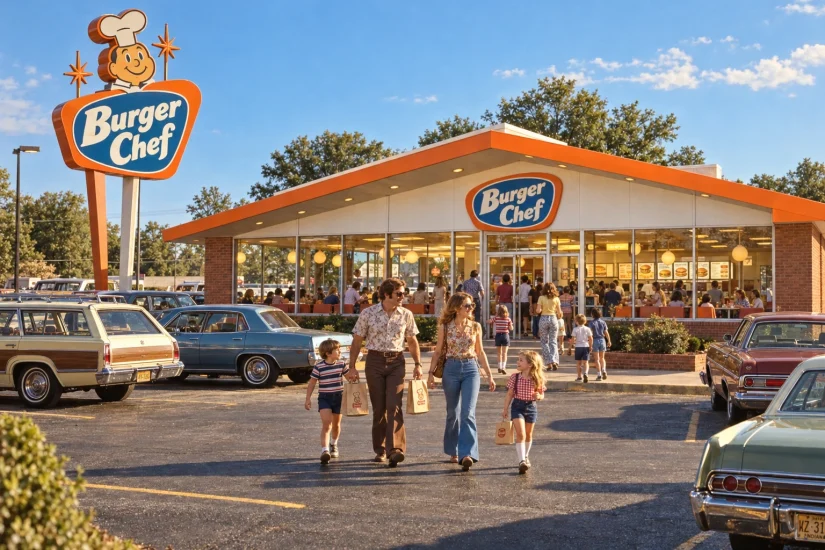
Burger Chef: Remembering Funmeals and Flame-Broiled Burgers in Indianapolis, Indiana
Burger Chef began in Indianapolis and grew into one of America’s major hamburger chains. This story explores its early restaurants, memorable Funmeals, signature burgers, and gradual disappearance after its acquisition by Hardee’s parent company.
Opening
Burger Chef began with an unexpected discovery: selling hamburgers could be more successful than selling the equipment used to cook them.
In 1957, Frank Porter Thomas opened a pilot restaurant to demonstrate his automated hamburger grill. Customers responded to the inexpensive burgers. The following spring, Thomas and partner Bob Wildman opened the first branded Burger Chef at 1300 West 16th Street in Indianapolis.
That small beginning grew into a familiar roadside destination. Burger Chef offered flame-broiled burgers, children’s promotions, and restaurants that became part of family routines.
The chain is gone today. Most locations converted or closed after its 1982 acquisition, although the final Burger Chef franchise lasted until 1996.
At a Glance
| Detail | Information |
|---|---|
| Place | Burger Chef |
| Also known as | Burger Chef restaurants; Burger Chef Systems |
| Historical location | First branded restaurant: 1300 West 16th Street, Indianapolis, Indiana |
| Category | Fast-food hamburger restaurants |
| Opened/established | 1958, following a 1957 pilot restaurant |
| Closed/disappeared | Gradual conversions and closures after 1982; final franchise ended in 1996 |
| Current status | Original chain defunct |
| Remembered for | Flame-broiled burgers, Big Shef, Super Shef, Funmeals, Burger Chef and Jeff, and the Works Bar |
These dates distinguish the chain’s early experiments, first branded restaurant, acquisition, and final holdout.
How It Began
Burger Chef’s origins were closely tied to restaurant equipment.
Historical accounts connect brothers Frank and Donald Thomas with the development of automated flame-broiling equipment. Frank’s Indianapolis restaurant with Bob Wildman helped turn that technology into a growing restaurant business.
The early concept emphasized inexpensive food and efficient service. Franchising allowed local operators to bring Burger Chef to additional communities.
By 1959, eight restaurants operated across Indiana, Ohio, and Missouri. Expansion continued during the 1960s, placing Burger Chef among the significant competitors in America’s developing fast-food industry.
What Made It Special
Burgers customers remembered by name
The Big Shef and Super Shef gave Burger Chef recognizable menu favorites.
Alongside its flame-broiling heritage, those names helped distinguish the restaurant from other hamburger chains. Customers could develop a favorite order and return knowing exactly what they wanted.
Funmeals made lunch feel like an event
Burger Chef introduced the Funmeal in 1973.
Its colorful packaging and toy prizes helped make the meal appealing beyond the food itself. Burger Chef and Jeff appeared on packaging, connecting the restaurant’s advertising characters with something children could take home.
The Funmeal became an important early example of fast food marketed specifically to children.
Burger Chef and Jeff brought personality to the brand
The cartoon chef and his sidekick Jeff became familiar figures in advertising during the late 1960s and 1970s.
Their presence carried across promotions and meal packaging. This gave Burger Chef a playful identity that families could recognize before stepping inside.
The Works Bar encouraged customization
The Works Bar offered customers a self-service way to add toppings to their meals.
Historical reporting identifies it among the features introduced during the chain’s expansion under General Foods. It provided a different experience from receiving a sandwich prepared entirely behind the counter.
The buildings became neighborhood landmarks
Some earlier Burger Chef restaurants used distinctive A-frame designs. Later buildings looked different, so the chain did not have one unchanging architectural style.
For local customers, the restaurant could become a familiar stop after school, during a shopping trip, or on a family drive. A photograph of the sign or roofline may bring back those visits as clearly as the menu.
The Final Chapter
General Foods acquired Burger Chef in 1968. The business continued developing its menu and promotions, but competition and declining performance weakened its position.
The planned sale to Hardee’s was announced in December 1981. Imasco, Hardee’s parent company, completed the acquisition in 1982.
Many Burger Chef restaurants then became Hardee’s locations. Others closed. The change happened gradually, meaning customers in different communities remember different endings.
Some franchisees continued operating under the Burger Chef name. The final franchise in Cookeville, Tennessee, ended its Burger Chef run in 1996 and became Pleasers.
The chain’s disappearance therefore involved both rebranding and closure. It was not a single nationwide shutdown on one date.
What’s There Now?
Former Burger Chef properties have separate histories.
Some buildings became Hardee’s restaurants. Others were altered, reused, or removed. A historical conversion does not establish who occupies a property today.
This overview covers the chain rather than one verified restaurant site. The present condition of the original Indianapolis property has not been confirmed for this article.
A location-specific story should check the address against current property records, tenant information, planning documents, and dated photographs. Surviving architectural details can offer clues, but they need supporting evidence.
Current-site verification: No individual former Burger Chef property verified as of October 12, 2026.
Do You Remember Burger Chef?
Did you order a Big Shef, collect a Funmeal toy, or head straight to the Works Bar? Which Burger Chef location did your family visit, and approximately what year was it?
Share your memories in the comments.
If you have old restaurant photographs, menus, advertisements, receipts, or employee keepsakes, tell Forgotten Spots about them. Include any known dates and whether you own the material or have permission to share it.
Your contribution could help document a neighborhood restaurant whose sign has long since disappeared.
Sources and Credits
- Encyclopedia of Indianapolis — Burger Chef: Early restaurant history, Indianapolis address, expansion, and General Foods ownership.
- Indianapolis Business Journal — Burger Chef, Indy’s biggest-ever restaurant chain: Broiling heritage, Funmeal, Works Bar, and franchise history.
- Historic Indianapolis — Burger Chef advertising history: Characters, promotions, packaging, and restaurant architecture.
- UPI — December 10, 1981 acquisition announcement: Contemporary reporting on the planned purchase.
- WRTV — 1982: Bye-bye Burger Chef, hello Hardee’s: Acquisition and final-franchise history.
- TIME — A Brief History of the Real-World Burger Chef: Final Cookeville location and its 1996 transition.