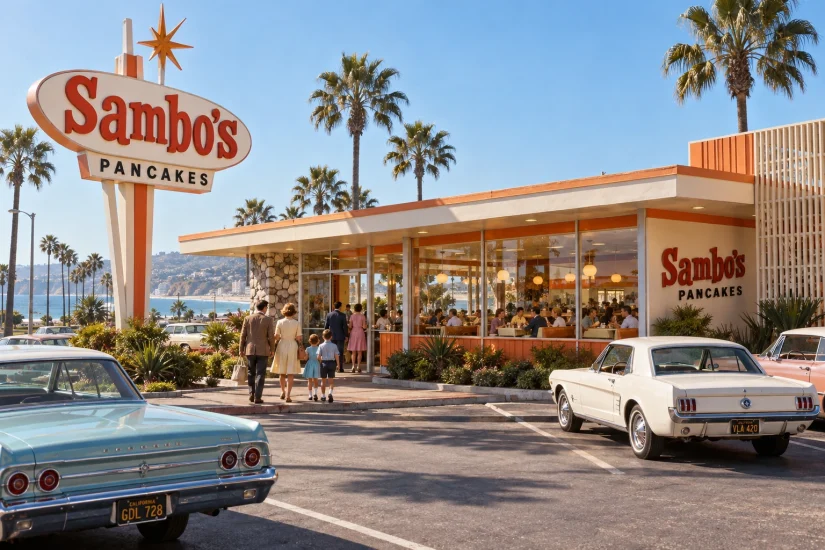
Sambo’s: Remembering Pancake Breakfasts and a Complicated Legacy
Sambo’s began in Santa Barbara in 1957 and grew into a nationwide restaurant chain known for pancakes and diner meals. Its history includes rapid expansion, financial collapse, and controversy over racist imagery and branding.
OPENING
At Sambo’s, the pancakes and the restaurant’s decorations were connected through a children’s story.
The chain displayed scenes associated with The Story of Little Black Sambo, including tigers and a boy. That branding became central to a controversy that followed the business for decades.
For some customers, Sambo’s brings back memories of breakfast and family meals. For others, its name and imagery recall degrading racial stereotypes. Both experiences belong in an honest account of the restaurant’s history.
The national chain disappeared during the early 1980s. Its original Santa Barbara restaurant kept the name until 2020, when it became Chad’s.
AT A GLANCE
Place: Sambo’s
Also known as: Some locations operated as The Jolly Tiger or No Place Like Sam’s; the original restaurant became Chad’s
Historical location: Founded at 216 West Cabrillo Boulevard, Santa Barbara, California; later expanded nationwide
Category: Pancake houses and family restaurants
Opened/established: June 17, 1957
Closed/disappeared: Filed for bankruptcy in November 1981; the chain dissolved through closures, sales, and rebranding during the early 1980s
Current status: The original location continues as Chad’s Café
Remembered for: Pancake breakfasts, diner meals, nationwide expansion, and controversy over its name and racial imagery
HOW IT BEGAN
Sam Battistone Sr. and Newell “Bo” Bohnett opened the first Sambo’s near the Santa Barbara waterfront on June 17, 1957.
The founders’ explanation for the name combined “Sam” with “Bo.” However, the restaurant also deliberately used illustrations associated with The Story of Little Black Sambo. The founders’ names therefore do not explain the full branding history.
What began as a local pancake restaurant expanded into a much larger business.
During the 1960s, Sambo’s spread beyond California into other western states. Its growth accelerated, and by 1979 the chain had more than 1,100 restaurants across 47 states.
The waterfront restaurant became the starting point for a national name. It would also become the final location to retain that name.
WHAT MADE IT SPECIAL
Breakfast was central to Sambo’s identity. Pancakes offered a recognizable connection between the menu and the storybook scenes decorating its restaurants.
The chain also served diner meals, making it a place for more than a morning stop. Its family marketing included a children’s club associated with its tiger imagery.
However, those decorations carried a history that cannot be separated from the dining experience.
The Smithsonian explains that Helen Bannerman’s original 1899 story was set in India. Later American illustrations often transformed its characters into racist caricatures of Black people.
The word used in the restaurant’s name also had an established history as an anti-Black slur. Consequently, criticism addressed both the name and the stereotypes associated with its imagery.
Customers could have fond memories of a meal while the same branding made other people feel demeaned or unwelcome. Preserving the restaurant’s history means acknowledging that difference.
THE FINAL CHAPTER
During the 1970s, Sambo’s faced protests and legal disputes over its name. Some restaurants used alternative identities, including The Jolly Tiger and later No Place Like Sam’s.
Meanwhile, the company developed serious financial and management problems. It filed for Chapter 11 bankruptcy protection in November 1981.
The chain subsequently broke apart. Restaurants closed, changed names, or were sold to other operators. Some former locations became Denny’s or Bakers Square restaurants.
The collapse had several causes. The branding controversy was significant, but financial and operational problems also shaped the outcome.
The original Santa Barbara restaurant survived separately and retained the Sambo’s name for decades.
In 2020, renewed calls for racial justice brought another push to change it. Local organizer Rashelle Monet led a petition campaign. The owners covered the old sign in June, and a permanent Chad’s sign followed in July.
WHAT’S THERE NOW?
Chad’s Café operates at 216 West Cabrillo Boulevard in Santa Barbara, California, the original restaurant address.
Its official website advertises breakfast and lunch, including buttermilk pancakes, Eggs Benedict, and steak and eggs. It identifies Chad Stevens, the founder’s grandson, as continuing the family business.
The restaurant’s website lists daily service from 7 a.m. to 2:30 p.m. Its advertised operating status and address were checked on October 14, 2026.
The site offers a direct connection to the restaurant’s beginnings, although the former name has been retired.
Other former Sambo’s properties have separate histories. A confirmed street address is needed to establish whether a particular building survives and what occupies it today.
DO YOU REMEMBER SAMBO’S?
Which location did you visit, and what do you remember about its breakfasts? Do you recall the wall illustrations, community objections, or a later name change?
Share your memories with Forgotten Spots. Experiences from former customers, employees, and people affected by the branding can all help document the story.
Photographs, menus, advertisements, and local newspaper reports are welcome. Please identify who owns submitted materials and whether they may be published.
SOURCES AND CREDITS
- KEYT — “American Restaurant History Changes in Santa Barbara with the End of Sambo’s”, June 5, 2020: Founders and opening date.
- Delaney Smith — “The Symbol of Sambo’s,” Santa Barbara Independent, June 8, 2020: Branding controversy, owners’ explanation, and the petition campaign.
- Smithsonian National Museum of American History — Storybook Character and Racial Imagery: Historical context for the book’s American illustrations.
- KEYT — “It’s Official: Chad’s Replaces Sambo’s After 63 Years”, July 15, 2020: Permanent restaurant name change.
- Chad’s Café — Official Website: Current restaurant identity, address, and advertised service.
- Sambo’s — Historical Overview: Supplemental expansion, bankruptcy, and restaurant-conversion chronology.