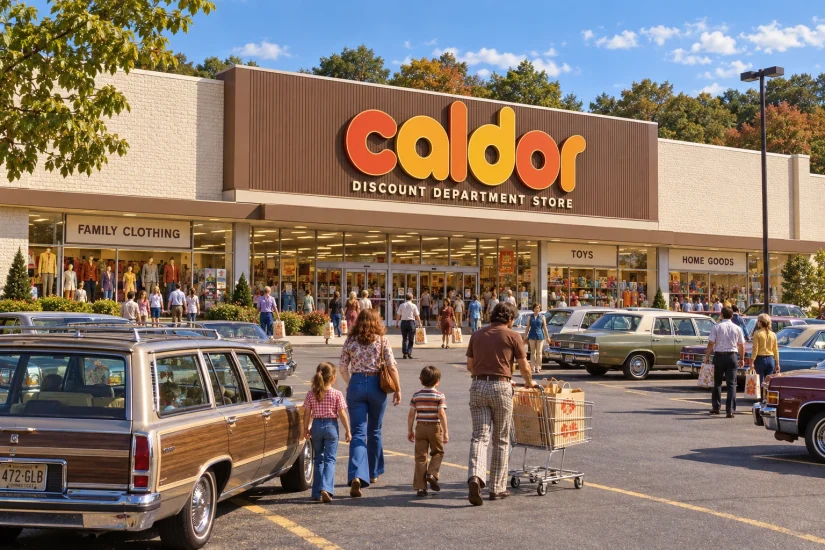
Caldor: Remembering Family Fashions and Discount Shopping
Caldor grew from a small Port Chester store into a Northeastern shopping favorite. Explore its beginnings, clothing and household departments, and the financial troubles that ended the chain in 1999.
OPENING
Caldor’s name began with two people: Carl and Dorothy Bennett.
The couple combined their first names when they opened their business in 1951. From that small beginning, Caldor developed into a familiar destination for family shopping across the Northeast.
Its clothing, toys, and household departments gave shoppers several reasons to visit. Weekly circulars encouraged customers to return for advertised specials.
The stores disappeared in 1999, but the name remains part of the region’s retail memories.
AT A GLANCE
Place: Caldor
Also known as: Caldor Department Stores
Historical location: Founded in Port Chester, New York; later headquartered in Norwalk, Connecticut; expanded throughout the Northeast and Mid-Atlantic
Category: Discount department stores
Opened/established: 1951
Closed/disappeared: Bankruptcy filing in 1995; liquidation and final closures in 1999
Current status: The original chain no longer operates
Remembered for: Clothing, toys, home goods, weekly sales circulars, and its colorful store identity
HOW IT BEGAN
Carl and Dorothy Bennett opened their first store in Port Chester, New York, in 1951.
Their idea paired quality merchandise with discount prices. As the assortment expanded, the business developed beyond its original small-store operation.
A preserved company webpage describes early departments devoted to gifts and cameras. Later additions included more household merchandise and apparel.
During the 1960s and 1970s, Caldor expanded through Connecticut, New York, and Massachusetts.
Its own historical account records 42 stores by the mid-1970s.
That growth placed Caldor within the broader rise of regional discount chains. These stores offered families a combination of practical purchases and browsing under one roof.
WHAT MADE IT SPECIAL
Caldor emphasized more than low prices.
Its preserved 1998 company description presented a business focused on national and private-label merchandise, family clothing, and home fashions.
That positioning helped distinguish it from a store built only around the cheapest available goods.
The broad selection also made Caldor useful for family shopping. Clothing and household purchases could share a trip with gifts or toys.
Weekly circulars played an important role. The company described them as a central part of its promotional strategy, bringing an assortment of advertised merchandise to customers’ attention.
Those circulars now provide evidence of what the store sold and how it presented itself.
The company also described community programs in which employees worked with local organizations. These activities included neighborhood cleanups and assistance to community agencies.
Such records show how the business operated within the towns it served, alongside its more familiar shopping role.
THE FINAL CHAPTER
The Bennetts sold Caldor to Associated Dry Goods in 1981.
Further ownership changes followed, including a period under May Department Stores and a later investor group. Caldor returned to public trading in 1991.
However, its financial position weakened during the 1990s.
The company filed for Chapter 11 bankruptcy protection on September 18, 1995.
Stores continued operating while the business attempted to reorganize. That process did not produce a lasting recovery.
On January 22, 1999, the bankruptcy court approved the company’s decision to wind down its business.
Liquidation sales followed. The remaining stores closed by May 1999, ending nearly five decades of operation.
For employees and regular shoppers, the final sales marked the loss of a familiar regional business. Merchandise and fixtures left the buildings as the Caldor name disappeared from shopping centers.
WHAT’S THERE NOW?
Former Caldor stores have individual histories.
Some buildings continued under other retail names, while others were divided among tenants or redeveloped.
A confirmed street address is needed to identify what occupies a particular former location today. The chain’s closure does not establish whether its original building survives.
Historical material offers another way to revisit Caldor.
A preserved company website from 1998 describes its departments, promotional approach, and community programs. It records the business shortly before liquidation and should be read as a historical document.
Local photographs and advertisements also help trace individual stores.
Sources were reviewed on October 15, 2026. Current tenants and physical conditions at specific former Caldor locations were not independently verified for this story.
DO YOU REMEMBER CALDOR?
Which Caldor did your family visit? Do you remember shopping for school clothes, browsing toys, or checking the weekly circular for a sale?
Share your memories with Forgotten Spots. Include the town, street, and approximate year if you remember them.
Photographs, advertisements, shopping bags, receipts, employee materials, and store directories can help preserve this history. Please identify who owns submitted materials and whether they may be published.
SOURCES AND CREDITS
- Caldor — Preserved 1998 Company Webpage: Company origins, departments, expansion, promotional strategy, and community programs.
- CT Insider — Carl Bennett, Caldor Founder: Founding and regional expansion.
- In re Caldor — U.S. Court of Appeals Decision: Bankruptcy proceedings and the January 1999 wind-down decision.
- Forgotten New York — “Caldor, Fordham, 1999”: Historical documentation of a former location.
- Caldor — Historical Overview: Supplemental information about the chain and final closures.