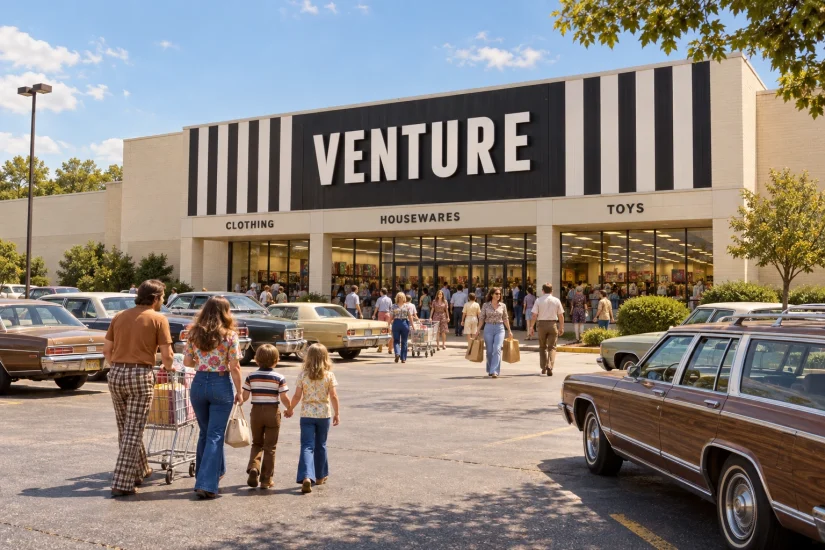
Venture: Remembering Black-and-White Storefronts and Family Shopping
Venture brought discount department-store shopping to the Midwest beginning in 1970. Explore its distinctive black-and-white branding, family merchandise, and the financial troubles that ended the chain in 1998.
OPENING
Venture’s black-and-white identity helped make its stores recognizable before shoppers reached the entrance.
Behind that striking branding was a broad assortment of clothing, household merchandise, toys, and other family purchases.
The chain’s first store opened in Overland, Missouri, in 1970. It became part of a regional shopping landscape that included large parking lots, busy shopping centers, and competing discount stores.
Venture disappeared in 1998, but its name remains connected to decades of Midwestern shopping.
AT A GLANCE
Place: Venture
Also known as: Venture Stores
Historical location: First store in Overland, Missouri, near St. Louis; expanded through the Midwest and into other markets
Category: Discount department stores
Opened/established: Business developed beginning in 1968; first store opened January 29, 1970
Closed/disappeared: Bankruptcy and liquidation in 1998
Current status: The original American chain no longer operates
Remembered for: Black-and-white branding, family clothing, household goods, toys, and suburban shopping
HOW IT BEGAN
Venture developed as May Department Stores’ entry into discount retailing.
Retail executive John Geisse, who had previously worked with Target, helped develop the concept alongside May executive Dave Babcock.
The first store opened in Overland, Missouri, on January 29, 1970.
A second location followed in Fairview Heights, Illinois, that March, placing the business on both sides of the St. Louis metropolitan area.
May expanded Venture gradually during the early and mid-1970s. The chain became a recognizable regional alternative to other discount retailers.
Its arrival reflected a larger change in American shopping. Customers increasingly expected broad merchandise selections, convenient parking, and prices suited to everyday family purchases.
WHAT MADE IT SPECIAL
Venture’s visual identity was one of its clearest distinctions.
Its black-and-white graphics stood apart from the bright colors used by many competing stores. The branding gave the chain a consistent appearance across signs and advertising.
Inside, the appeal came from variety.
Clothing, household merchandise, and toys made it possible to combine several errands in one visit. A practical shopping trip could also include time browsing departments that were not on the original list.
During its later expansion, Venture reached beyond its early Missouri and Illinois base.
A published company history records 114 stores in nine states in 1995, with important concentrations in Missouri, Illinois, and Texas.
That growth made Venture more than a single-city business. However, its origins remained firmly connected to the St. Louis area and the discount-store expansion of the 1970s.
THE FINAL CHAPTER
Venture’s later years brought financial difficulties and attempts to reshape the business.
The chain reduced its footprint, including moves away from some markets outside its core territory.
Those changes did not produce a lasting recovery.
Venture filed for Chapter 11 bankruptcy protection on January 20, 1998.
The company initially continued operating while seeking a way forward. By April, its plans had changed.
Contemporary corporate filings record that Venture announced its decision to liquidate on April 27, 1998.
Store-closing sales followed as the business disposed of inventory and its remaining operations.
The closing announcement and the completion of liquidation were separate events. The chain’s final chapter unfolded over several months rather than on one nationwide closing day.
WHAT’S THERE NOW?
Former Venture properties have different histories.
Some became stores operated by other retailers. Others were divided into smaller spaces, demolished, or redeveloped.
A historical account from UrbanReview STL traces the original Overland location through a later Kmart use and subsequent redevelopment for Home Depot.
That account was published in 2013. It documents the property’s reported history at that time, rather than independently confirming its present condition.
A specific street address and current property research are needed to establish what occupies any former Venture location today.
Historical sources were reviewed on October 15, 2026. No individual former store’s current tenant or physical condition was independently verified for this story.
Photographs, advertisements, shopping-center directories, and surviving signs remain useful ways to trace the chain’s earlier presence.
DO YOU REMEMBER VENTURE?
Did you recognize Venture by its black-and-white storefront? Which department did your family visit first—clothing, toys, or household goods?
Share your memories with Forgotten Spots. Include the town, street, and approximate year if you remember them.
Photographs, advertisements, shopping bags, receipts, employee materials, and store directories can help preserve this history. Please identify who owns submitted materials and whether they may be published.
SOURCES AND CREDITS
- Encyclopedia.com — Venture Stores Inc.: May Department Stores ownership, expansion, and later store network.
- Venture Stores — Historical Overview: Development, early openings, branding, and merchandise history.
- University of Florida Bankruptcy Research Database — Venture Stores: January 20, 1998, bankruptcy filing.
- Kimco Realty — 1998 Securities Filing: Venture’s bankruptcy and April liquidation announcement.
- Houston Historic Retail — Venture Department Stores: Later expansion and withdrawal from markets.
- UrbanReview STL — “Old Big Box Stores Live On, Some Too Long”: Historical account of the original Overland property.