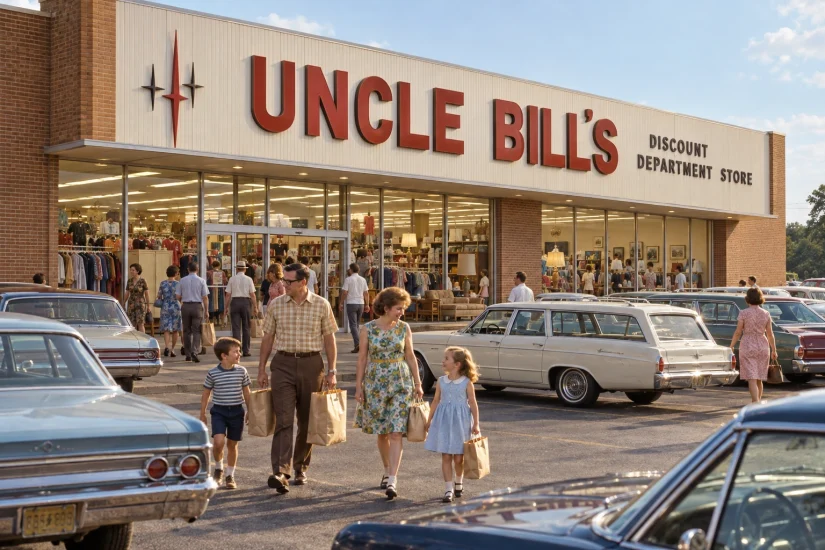
Uncle Bill’s: Remembering Clothing, Furniture, and Discount Shopping
Uncle Bill’s was a Greater Cleveland discount chain that expanded into clothing and furniture during the 1960s. Discover its local beginnings, its connection to Cook United, and its place in Ohio’s changing shopping landscape.
OPENING
In 1961, Uncle Bill’s added two departments that changed the scope of its business: clothing and furniture.
According to the Encyclopedia of Cleveland History, those additions transformed the local discounter into a complete discount department store. Customers could now shop for something to wear and something for their home under the same store name.
Uncle Bill’s has disappeared from Greater Cleveland’s retail landscape. However, its history offers a window into the years when regional discount chains challenged established department stores and reshaped family shopping.
AT A GLANCE
Place: Uncle Bill’s
Also known as: Uncle Bill’s Discount Department Stores
Historical location: Greater Cleveland, Ohio
Category: Discount department stores
Opened/established: 1955
Founder: Sidney Axelrod
Closed/disappeared: Individual store dates vary; no single chain-wide closing date established in the sources reviewed
Current status: Defunct retail chain
Remembered for: Discount shopping, clothing, furniture, and its connection to Cook United
HOW IT BEGAN
Sidney Axelrod founded Uncle Bill’s in 1955.
The business emerged during a period when Cleveland-area shopping was spreading beyond downtown. New shopping centers and suburban development gave retailers opportunities to reach customers closer to home.
In 1961, Axelrod sold his stores to Cook Coffee Company. The Encyclopedia of Cleveland History’s company history records the acquisition of five Uncle Bill’s locations that year.
Despite its name, Cook Coffee was already expanding far beyond coffee sales. Its interests included supermarkets, and discount department stores became another important part of its business.
The company adopted the Cook United name in 1969, reflecting its increasingly varied operations.
WHAT MADE IT SPECIAL
Uncle Bill’s brought a department-store range of merchandise into a discount setting.
Clothing and furniture served different household needs. Together, they made the store useful for both routine purchases and larger decisions about furnishing a home.
That combination also placed Uncle Bill’s within a wider change in customer expectations. Shoppers increasingly had alternatives to the traditional downtown shopping trip.
In Let’s Go Shopping at the Square, historian Richard Klein identifies Uncle Bill’s among the discounters competing with older Cleveland retailers such as Bailey’s. His account connects these businesses with younger customers seeking different shopping options.
Viewed in that context, Uncle Bill’s was more than another store sign. It represented a growing retail model built around selection and price.
For readers who remember a particular branch, the details may be more personal: a purchase for a first apartment, shopping for clothes, or working a busy shift. Those individual experiences deserve to be recorded with their locations and dates.
THE FINAL CHAPTER
Uncle Bill’s became part of a much larger corporate story after its sale.
Cook United expanded through acquisitions, but managing its many operations became difficult. During the 1970s, the company sold businesses and narrowed its activities.
Those changes did not restore lasting financial stability. Cook United filed for Chapter 11 bankruptcy in 1984 and again in 1987.
The Encyclopedia of Cleveland History reports that the company closed its last four Cleveland-area discount department stores during the summer of 1987. That November, its bankruptcy converted to Chapter 7 liquidation.
These dates document the parent company’s ending. They do not establish that every Uncle Bill’s branch operated under that name until 1987.
The closing, conversion, and later use of each store require a separate local history.
WHAT’S THERE NOW?
Uncle Bill’s was a chain, so there is no single former site to visit.
Its old locations must be traced individually through street addresses, city directories, newspaper advertisements, and property records. A building’s appearance alone may not reveal which retailer occupied it decades earlier.
This article does not verify current occupants, surviving buildings, or remaining signs at individual Uncle Bill’s properties.
If you remember a branch, its street address or nearby intersection can provide the starting point for a more detailed story.
DO YOU REMEMBER UNCLE BILL’S?
Which Uncle Bill’s location did your family visit? Do you remember buying clothing or furniture there—or working at one of its stores?
Share your memories with Forgotten Spots. Include the community, approximate year, and location when possible.
Photographs, receipts, advertisements, shopping bags, and employee materials can help preserve the chain’s history. Please identify the owner of any submitted material and whether permission for publication is available.
SOURCES AND CREDITS
- Encyclopedia of Cleveland History — Business, Retail: Founder, establishment date, merchandise expansion, sale, and Cleveland retail context.
- Encyclopedia of Cleveland History — Cook United, Inc.: Acquisition, corporate development, financial problems, and liquidation.
- Richard Klein — The People’s Stores: Taylor’s and Bailey’s: Uncle Bill’s role in competition between discount retailers and traditional department stores.