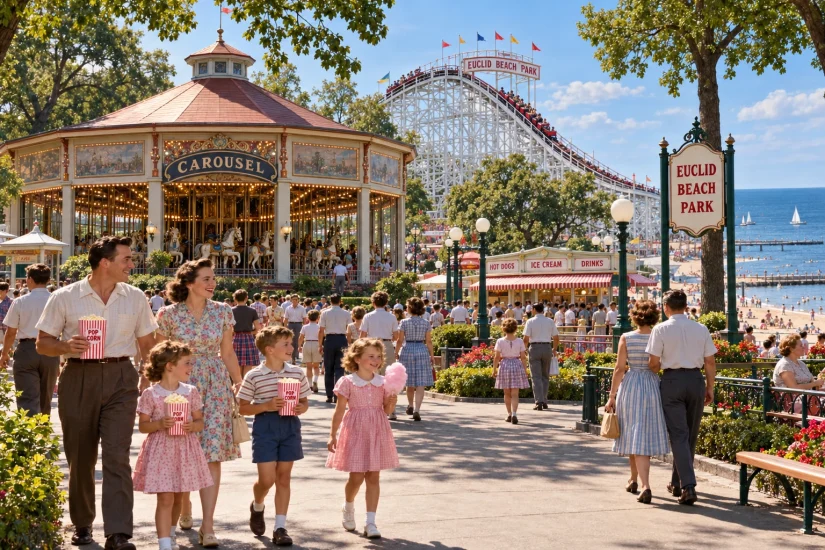
Euclid Beach Park: Remembering Roller Coasters and Lake Erie Summers in Cleveland, Ohio
Euclid Beach Park brought roller coasters, carousel rides, and lakefront outings to Cleveland for generations. Explore its history, its complicated legacy, its 1969 closing, and the surviving places where visitors can reconnect with its story.
OPENING
One of Euclid Beach Park’s most remarkable attractions survived the park itself.
Installed in 1910, its Grand Carousel carried riders through decades of Cleveland summers. After the amusement park closed, the carousel moved to Maine. Following its eventual return and restoration, it welcomed riders again at the Cleveland History Center in 2014.
That survival provides a tangible connection to a vanished destination: a place where Lake Erie outings, amusement rides, and family traditions once shared the same shoreline.
AT A GLANCE
Place: Euclid Beach Park
Also known as: Euclid Beach; Euclid Beach Amusement Park
Historical location: Lake Erie shoreline near East 156th Street in Cleveland’s Collinwood area
Category: Amusement parks and lakefront recreation
Opened/established: 1895
Closed/disappeared: September 28, 1969
Current status: Amusement park closed; portions of the former grounds remain public parkland, with surviving traces
Remembered for: Roller coasters, the Grand Carousel, lakefront outings, popcorn, and community gatherings
HOW IT BEGAN
Euclid Beach Park opened in 1895, during an era when amusement destinations brought rides and entertainment to urban waterfronts.
Its early business struggled. In 1901, Dudley S. Humphrey II and members of his family took over management.
The Humphreys developed a family-oriented destination with free admission to the grounds and a prohibition on beer. Streetcar access helped make a visit practical for Cleveland residents.
The park expanded its entertainment and bathing facilities. Families, employers, and community organizations made it a destination for group outings.
WHAT MADE IT SPECIAL
Euclid Beach offered several experiences in one setting: amusement rides, lake views, and room to spend time together.
The Cleveland Memory Project’s timeline records attractions including the Figure Eight roller coaster and Scenic Railway. The Grand Carousel added carved wooden horses, music, and a different pace from the coasters.
Other attractions developed their own identities. Euclid Beach Park Now documents the Great American Racing Derby, whose horses moved forward and backward as well as up and down. Its history also preserves attractions such as the Surprise House and Laughing Sal.
These details help explain why memories of the park extend beyond one favorite ride. Different visitors could remember an entirely different part of the same afternoon.
However, the park’s welcome was unequal.
Euclid Beach discriminated against African American visitors. In 1946, interracial groups and civil-rights organizations challenged those restrictions through visits and protests.
Confrontations included violence by park police. The events prompted Cleveland legislation addressing amusement-park licensing and racial discrimination.
Remembering Euclid Beach fully means preserving both its cherished traditions and the experiences of people denied equal access to them.
THE FINAL CHAPTER
Euclid Beach’s difficulties grew during the 1960s.
The Encyclopedia of Cleveland History identifies changing lifestyles, lake pollution, rising operating costs, and racial incidents among the factors behind declining attendance and revenue.
The Cleveland Memory Project records that the park began losing money in 1964.
Euclid Beach closed on September 28, 1969. The rides and buildings did not remain together as a preserved amusement park. The carousel’s departure was one part of that dispersal.
For Cleveland, the closing ended a familiar summer destination. Yet several physical connections survived.
WHAT’S THERE NOW?
Visitors can still reach the lakefront at today’s Euclid Beach Park, part of Cleveland Metroparks’ Euclid Creek Reservation.
Its official page lists a beach, shaded picnic areas, an observation pier, and a reservable pavilion. It also identifies surviving amusement-park traces: the shuffleboard area, beachside fountain remnants, and concrete foundations from the Flying Turns roller coaster.
The City of Cleveland lists the Euclid Beach Park Gateway Arch as a designated landmark at 16001 Lake Shore Boulevard.
The Grand Carousel stands elsewhere: at the Cleveland History Center, 10825 East Boulevard. Western Reserve Historical Society advertises rides on the restored attraction, including many original horses.
These official descriptions were checked online on October 17, 2026. No physical inspection was performed.
DO YOU REMEMBER EUCLID BEACH PARK?
Which ride do you remember most? Did your family visit for a company picnic, a lakefront outing, or an annual summer tradition?
Share your memories with Forgotten Spots. Include the approximate year, attraction, and people involved when possible.
Photographs, tickets, park maps, advertisements, and employee materials are welcome. Please identify who owns submitted items and whether permission for publication is available.
SOURCES AND CREDITS
- Encyclopedia of Cleveland History — Euclid Beach Park: Management, visitor policies, decline, and closing.
- Cleveland Memory Project — History of Euclid Beach Park: Historical timeline and attractions.
- Encyclopedia of Cleveland History — Euclid Beach Park Riot: Racial discrimination and the 1946 protests.
- Euclid Beach Park Now: Park history and attraction preservation.
- Cleveland Metroparks — Euclid Beach Park: Current public park and surviving traces.
- City of Cleveland — Gateway Arch: Landmark listing and address.
- Western Reserve Historical Society — Grand Carousel: Carousel history, restoration, and current location.