Red Barn: Remembering Barn-Shaped Fast Food in Springfield, Ohio
Red Barn began in Springfield, Ohio, in 1961 and grew into a recognizable fast-food chain. Discover its barn-shaped restaurants, Big Barney burgers, memorable advertising, and gradual disappearance.
Opening
Before customers reached the counter, Red Barn had already made an impression.
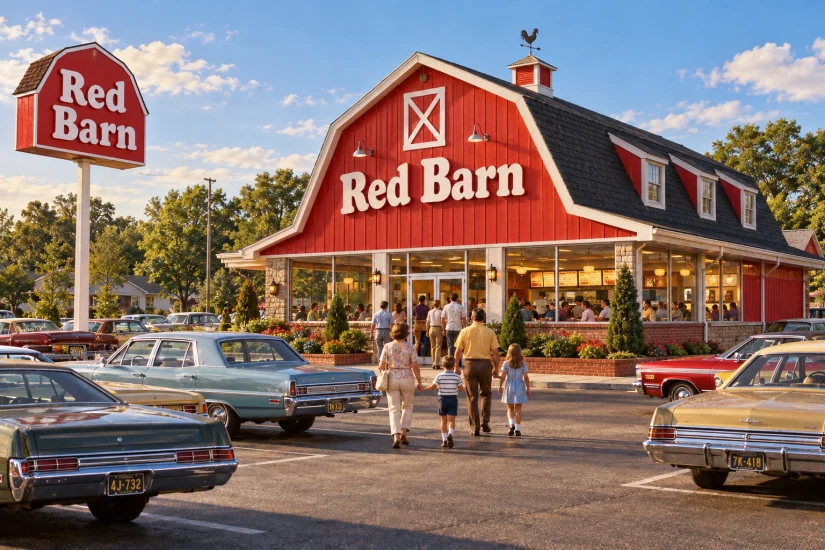
Its restaurants looked like miniature barns. Red exteriors, distinctive rooflines, and glass fronts turned a fast-food building into something drivers could recognize from the road. The architecture made the restaurant’s name part of the landscape.
Inside, customers could order burgers and fried chicken. Outside, the building promised a different kind of roadside stop.
Founded in Springfield, Ohio, Red Barn expanded far beyond its hometown. The original chain eventually disappeared, leaving behind old advertisements, photographs, and memories of meals beneath that familiar roof.
At a Glance
| Detail | History |
|---|---|
| Place | Red Barn |
| Also known as | Red Barn restaurants; Red Barn System |
| Historical location | Founded in Springfield, Ohio; expanded across the United States and into Canada and Australia |
| Category | Fast-food restaurant chain |
| Opened/established | 1961 |
| Closed/disappeared | Gradually declined; chain shutdown commonly dated to around 1988 |
| Current status | Original chain defunct; individual former properties require separate verification |
| Remembered for | Barn-shaped buildings, Big Barney and Barnbuster burgers, fried chicken, and food-themed mascots |
Founding and expansion are documented by the Dayton Daily News. Historical accounts describe a gradual shutdown, so 1988 should not be treated as every restaurant’s closing year.
How It Began
Don Six, Jim Kirst, and Martin Levine founded Red Barn in Springfield, Ohio, in 1961.
The business developed during an era when fast-food restaurants were becoming familiar roadside destinations. Red Barn gave customers a name and building they could connect immediately: a restaurant called Red Barn that actually resembled one.
From its Ohio beginnings, the chain expanded across the country and reached Canada and Australia. That growth made an idea born in Springfield recognizable to customers far from home.
What Made It Special
A building that advertised the restaurant
Red Barn’s architecture was central to its identity.
Historical descriptions document barn-shaped buildings with glass fronts and limited seating. Customers ordered at a counter and could eat there or take their meals home.
The design also created a lasting visual connection. A photograph of the roofline can bring the restaurant to mind even when the original sign is missing.
Burgers with memorable names
Two signature burgers helped define the menu: the Big Barney and the Barnbuster.
Both appear in the Dayton Daily News’ account of the chain. Their names reinforced the barn theme while giving customers something distinctive to order.
Fried chicken was another important offering. A historical advertisement reproduced by the Hagen History Center promoted a 99-cent chicken dinner with three pieces of chicken, fries, coleslaw, and a roll.
That price belongs to the period advertisement. It illustrates how Red Barn presented a complete meal to customers at the time.
Characters that brought the menu to life
Red Barn promoted its food through characters called Hamburger Hungry, Chicken Hungry, and Big Fish Hungry.
These mascots gave the chain a playful advertising identity. Rather than relying only on photographs of meals, Red Barn turned its menu into recognizable characters.
A local place within a larger chain
Although Red Barn became an international business, each restaurant also occupied a particular place in a community.
The Hagen History Center documents four former Erie, Pennsylvania, locations. Those addresses show why local research matters: one chain could become part of several neighborhoods, with different customers and different histories.
For a former customer, “Red Barn” may mean one particular intersection, an after-school meal, or a family’s regular takeout stop.
The Final Chapter
Red Barn’s disappearance happened gradually.
The Dayton Daily News reports that the chain was sold in the late 1970s and eventually closed. The Hagen History Center connects its decline with competition from larger fast-food businesses and a series of corporate buyouts and restructuring.
A Kiplinger retrospective reports that restaurants closed as leases expired around 1988. This helps explain why there is no single closing date that applies to every Red Barn location.
Some former restaurants continued independently under the name The Farm, preserving parts of the old restaurant concept. Those successor businesses belong to the story, but their histories should be distinguished from the original chain.
The buildings also followed different paths. Some changed uses, while others disappeared. A local restaurant’s final chapter therefore requires more than the chain’s general history.
What’s There Now?
Without a specific address, there is no single property to identify.
Historical sources document former Red Barn sites and later uses. However, an older account cannot establish what occupies a property today.
For example, the Hagen History Center’s 2021 article identified a Taco Bell on the former Red Barn lot on Park Avenue in Meadville, Pennsylvania. That is a dated observation, not a verified October 2026 site report.
A local follow-up should check the exact address against current business listings, property records, and dated photographs. Surviving rooflines or signs may offer clues, but they need supporting evidence.
Current-site verification: No individual Red Barn property has been verified for this chain overview as of October 12, 2026.
Do You Remember Red Barn?
Was your usual order a Big Barney, a Barnbuster, or a chicken dinner? Which city’s Red Barn did you visit, and do you remember the building or advertising characters?
Share your memories in the comments, including the location and approximate year.
If you have an old menu, restaurant photograph, advertisement, or employee keepsake, tell Forgotten Spots about it. Please include any known dates and whether you own the material or have permission to share it.
Your contribution could help turn a chain overview into a detailed story about a neighborhood restaurant.
Sources and Credits
- Dayton Daily News — “6 delicious restaurant chains that were born in the Miami Valley”, by Lisa Powell, June 6, 2017. Supports the founding year, founders, Springfield origins, menu names, and expansion.
- Hagen History Center — “Nostalgia—A Look Back into the Not-So-Distant Past”, by Jeff Sherry, October 22, 2021. Documents architecture, menu items, advertising, Erie locations, and historical images.
- Kiplinger — “Classic Restaurant Chains: Where Are They Now?”. Provides an account of the gradual closures around 1988.
- Red Barn historical overview — Wikipedia. Supplemental reference for successor restaurants operating as The Farm.