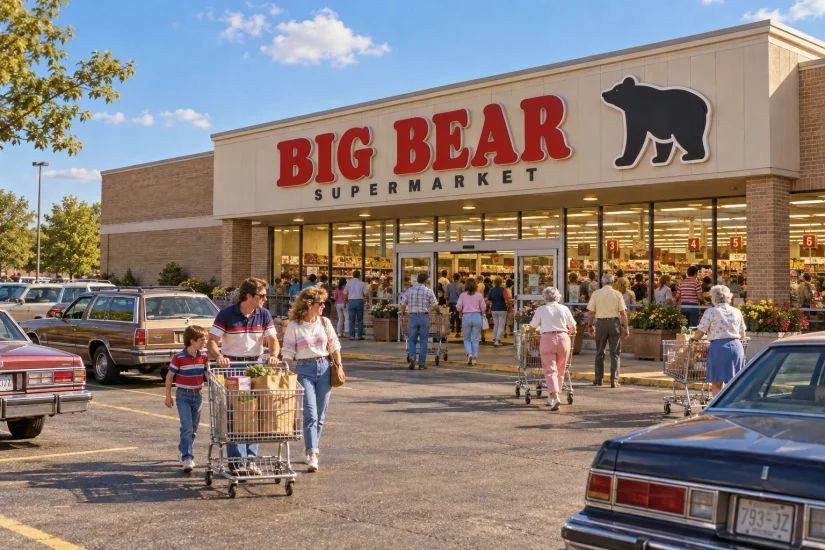
Big Bear Stores: Remembering a Columbus Grocery Tradition in Columbus, Ohio
Big Bear Stores helped change how Columbus families bought groceries. Explore its pioneering Lane Avenue supermarket, familiar shopping traditions, regional growth, and final disappearance in 2004.
Opening
Big Bear’s earliest customers encountered something unusual: a grocery store where they could choose merchandise themselves—and a real bear near the entrance.
Ohio History Connection documents the trained bear that became an attraction at the original store. It performed tricks for visitors before eventually being donated to the Columbus Zoo.
The animal drew attention, but the shopping concept was the lasting innovation.
Big Bear brought self-service grocery shopping to Columbus on a large scale. Over the following decades, its stores became familiar destinations for families across the region.
The chain disappeared in 2004, following its parent company’s bankruptcy and the sale or closure of its remaining stores.
At a Glance
| Detail | Information |
|---|---|
| Place | Big Bear Stores |
| Also known as | Big Bear; Big Bear supermarkets; Big Bear Plus |
| Historical location | First store at 386 West Lane Avenue, Columbus, Ohio |
| Category | Regional supermarket chain |
| Opened/established | Company founded in November 1933; first store opened February 15, 1934 |
| Closed/disappeared | Final stores closed or changed ownership by early 2004 |
| Current status | Original chain defunct |
| Remembered for | Self-service grocery shopping, Buckeye trading stamps, bakery operations, and its Columbus roots |
The founding and first-store dates are documented by local historical sources. The company’s establishment in 1933 should be distinguished from its first supermarket opening in 1934.
How It Began
Wayne E. Brown founded Big Bear after years of experience in the grocery business.
His idea gave customers more freedom to browse and select their own purchases. Instead of asking a clerk to retrieve each product, shoppers could gather merchandise and pay before leaving.
Brown opened the first store in a large building on West Lane Avenue near Ohio State University. The property had previously served as a dance hall and skating rink.
The approximately 47,000-square-foot store combined groceries with several additional services, including a drugstore, restaurant, candy department, and shoe repair shop.
It offered an ambitious version of one-stop shopping during the Great Depression.
What Made It Special
Customers could shop for themselves
Big Bear helped establish the self-service supermarket model in the region.
Ohio History Connection identifies it as the Midwest’s first self-service supermarket. The format allowed customers to browse a broad assortment and gather more of their shopping in one visit.
What feels ordinary in a supermarket today represented a substantial change in grocery retailing.
The store experience kept evolving
Big Bear continued adopting new approaches after its first opening.
Local historical accounts document shopping carts introduced in 1937 and cashier-operated motorized conveyor belts. These features helped move grocery shopping toward the experience customers recognize today.
The chain’s history illustrates how familiar supermarket routines developed through practical changes to stores and equipment.
Buckeye stamps rewarded regular shopping
For many customers, Big Bear also meant collecting Buckeye trading stamps.
The orange-and-blue stamps could be redeemed for merchandise or cash discounts. They gave shoppers another reason to return and connected weekly purchases with a reward beyond the groceries themselves.
Old stamp books are valuable reminders of a period when loyalty programs took a physical form that families kept at home.
Big Bear Plus expanded the shopping trip
The company also operated Big Bear Plus stores, combining groceries with substantial general-merchandise departments.
A historical company profile describes an assortment extending into clothing, toys, craft supplies, sporting goods, and small appliances.
This broader format made some locations destinations for more than the weekly food shop.
A business rooted in Columbus
Big Bear’s headquarters, warehouses, and bakery operations tied the chain closely to Central Ohio.
Its headquarters and main warehouses stood along Goodale Boulevard in Grandview Heights. They supported a regional business whose name remained closely associated with Columbus.
The Ohio History Connection preserves memorabilia from the chain, a collection featured by WOSU’s Columbus Neighborhoods.
The Final Chapter
Penn Traffic took ownership
Penn Traffic acquired Big Bear in 1989.
The chain continued operating under its familiar name, but its future became connected with the larger supermarket company’s financial condition.
Bankruptcy brought closures and sales
Penn Traffic filed for bankruptcy protection in May 2003.
By late that year, it was seeking to dispose of the Big Bear chain. Contemporary trade reporting documented Giant Eagle’s proposed purchase of seven supermarkets, with plans to briefly close and reopen them under new ownership.
The transition differed from location to location. Some stores found buyers, while others closed.
The Big Bear name disappeared
Early 2004 brought the end of Big Bear’s supermarket operations.
Reporting on former stores reopening as Giant Eagle described liquidation sales continuing through January 18, 2004, at most of the acquired locations. The buildings then underwent restocking and remerchandising.
For customers, that could mean returning to a familiar address and finding a different grocery chain.
Big Bear’s disappearance ended roughly seven decades of shopping under the name.
What’s There Now?
Two important sites help trace Big Bear’s physical legacy.
The Grandview historical walking-tour account identifies the original Lane Avenue store site with Riverwatch Tower apartments. It places the former Goodale Boulevard headquarters and warehouse area within Grandview Yard.
Those are documented historical site identifications. They have not been independently checked against current property records for this article.
Former neighborhood stores have separate histories. Some reopened under other supermarket names, while others were repurposed or removed. An exact address is needed to establish a particular building’s current use.
Current-site verification: Historical site identifications reviewed October 12, 2026; no individual property independently verified through current records or a site visit.
Do You Remember Big Bear Stores?
Which Big Bear did your family shop at? Do you remember collecting Buckeye stamps, choosing something from the bakery, or browsing a Big Bear Plus store?
Share the location and approximate year in the comments.
If you worked for Big Bear, we would also love to hear about your store, department, or daily routine.
Have old photographs, advertisements, receipts, shopping bags, or stamp books? Tell Forgotten Spots about them. Please include any known dates and whether you own the material or have permission to share it.
These everyday objects can help preserve the history of a grocery chain woven into generations of family life.
Sources and Credits
- Ohio History Connection / Ohio Memory — Big Bear: The Original Columbus Supermarket: Wayne Brown, the original store, self-service shopping, historical photographs, and the trained bear.
- Grandview Historical Walking Tour — Big Bear Stores: Headquarters, shopping innovations, Buckeye stamps, acquisition, and historical site identifications.
- Grandview Heights/Marble Cliff Historical Society — Big Bear history: Company founding and first-store opening dates.
- FundingUniverse — History of Big Bear Stores Co.: Historical company profile and expanded merchandise formats.
- Supermarket News — Giant Eagle Expands in Columbus: Contemporary reporting on Penn Traffic’s bankruptcy and store sales.
- Visual Merchandising and Store Design — The Giant Eagle Has Landed in Ohio: Early-2004 liquidation and reopening information.
- PBS / WOSU — From the Vault: Big Bear: Coverage of preserved Big Bear memorabilia.