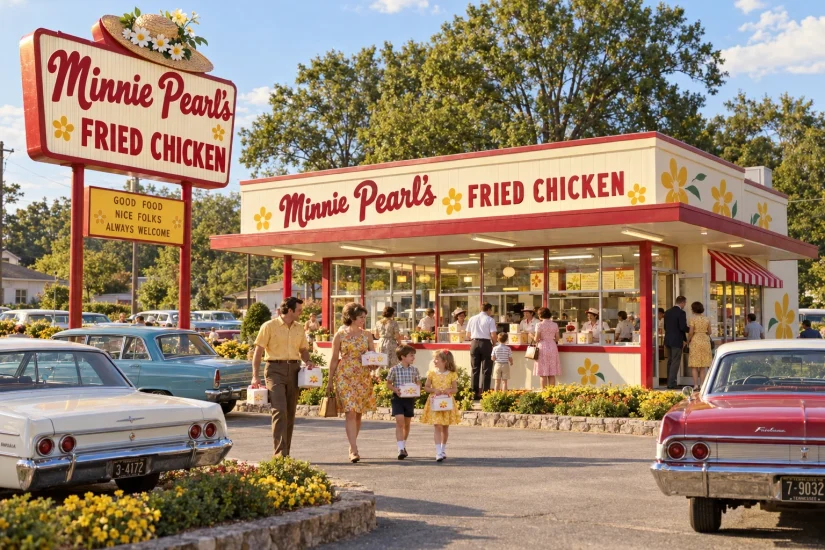
Minnie Pearl’s Fried Chicken: Remembering a Country Comedy Star’s Restaurant Chain
Minnie Pearl’s Fried Chicken launched in the late 1960s with ambitions to compete against Kentucky Fried Chicken. Discover how a beloved entertainer’s name helped sell a restaurant concept—and why rapid expansion failed to create a lasting chain.
OPENING
In June 1967, Minnie Pearl’s Fried Chicken was making headlines before the company had sold its first drumstick.
A newspaper announcement promoted a new restaurant venture bearing the name of one of country entertainment’s most recognizable personalities. Entrepreneur John Jay Hooker predicted hundreds of restaurants within a few years.
The idea seemed promising: pair a familiar celebrity with a popular meal and build a competitor to Kentucky Fried Chicken.
The chain expanded, but its restaurant operations struggled to match the excitement surrounding its franchises and stock. Within a few years, the ambitious venture was unraveling.
AT A GLANCE
Place: Minnie Pearl’s Fried Chicken
Also known as: Minnie Pearl’s Chicken; Minnie Pearl’s Chicken Systems
Historical location: Developed in Nashville, Tennessee, with franchises established in multiple markets
Category: Celebrity-branded fried chicken restaurants
Opened/established: Announced in 1967; restaurant expansion followed in the late 1960s
Closed/disappeared: Major contraction around 1970; the business faded during the early-to-mid-1970s
Current status: The original chain no longer operates
Remembered for: Minnie Pearl’s celebrity image, fried chicken meals, ambitious franchising, and a rapid business collapse
HOW IT BEGAN
Nashville attorney and entrepreneur John Jay Hooker, working with his brother Henry Hooker, saw an opportunity in the growing fried chicken business.
Kentucky Fried Chicken had demonstrated that a recognizable personality and a franchised restaurant system could reach a national audience.
The Hookers recruited Minnie Pearl, the stage character portrayed by entertainer Sarah Ophelia Colley Cannon, to lend her name to their venture.
Her familiar image offered instant recognition. Customers already knew Minnie Pearl from the Grand Ole Opry and her comedy performances.
The business announcement appeared in June 1967. By 1968, the company was attracting substantial attention from investors and prospective franchise operators.
Its plans reached beyond chicken. In January 1969, the parent company adopted the name Performance Systems Inc., reflecting ambitions to develop additional businesses.
WHAT MADE IT SPECIAL
The restaurant’s strongest distinction was its connection to Minnie Pearl.
Her public personality suggested friendliness, humor, and country hospitality. That association gave the business a ready-made identity in a crowded restaurant market.
Even its buildings drew on her image. According to business historian Bill Carey’s account, architect Earl Swensson developed a restaurant design using colors associated with Minnie Pearl’s famous hat.
Contemporary publicity also connected the chicken with a family recipe. An advertisement in a 1967 issue of Billboard presented that claim as part of the franchise’s appeal.
However, promotional promises and restaurant performance were different matters. Later reporting described difficulties producing a consistently appealing product across locations.
The story illustrates an important part of restaurant history: celebrity recognition can draw attention, while dependable food and effective operations determine whether customers return.
THE FINAL CHAPTER
The chain’s expansion moved faster than its restaurant experience could support.
Carey’s historical account describes inexperienced leadership, disappointing food, and heavy losses. By late summer 1970, more than half of approximately 250 restaurants opened by the company had closed.
Financial reporting became another major issue.
The Securities and Exchange Commission investigated how the company recognized franchise-fee income. The questions included whether unpaid portions of franchise agreements should have been recorded as income.
The Tennessee State Library and Archives’ account reports that the investigation ended without charges against Hooker or the company. That distinction matters: an investigation should not be presented as a criminal conviction.
Nevertheless, the business was already in serious difficulty. Restaurant closures, operating losses, and shaken investor confidence contributed to its decline.
Its disappearance unfolded over several years, making one nationwide closing date difficult to establish.
WHAT’S THERE NOW?
The original Minnie Pearl’s Fried Chicken chain no longer operates.
Because its restaurants occupied multiple locations, there is no single replacement business that represents what happened to the chain.
A former restaurant might have been converted, demolished, or redeveloped. Each property requires a confirmed address and separate research before its present use can be identified.
Historical materials provide a more dependable surviving connection. Newspaper accounts, franchise advertisements, and archival histories document how the business developed and declined.
The Tennessee State Library and Archives preserves an account of Hooker’s career that includes the chicken venture. Contemporary advertisements also survive in digitized entertainment publications.
Sources were reviewed on October 14, 2026. No individual former restaurant property’s present condition was independently verified for this story.
DO YOU REMEMBER MINNIE PEARL’S FRIED CHICKEN?
Did you visit a Minnie Pearl’s restaurant, or did someone in your family work at one? Do you remember its sign, packaging, or the entertainer’s image in its advertising?
Share your memories with Forgotten Spots. Include the town, street, and approximate year if you remember them.
Photographs, menus, newspaper advertisements, employee materials, and franchise documents can help preserve this short-lived restaurant story. Please identify who owns submitted materials and whether they may be published.
SOURCES AND CREDITS
- Tennessee State Library and Archives — “Tri-Star Chronicles: John Jay Hooker Jr.”: Business ambitions, franchise-fee investigation, and reported outcome.
- Nashville Scene — “Failed Fortunes”: Bill Carey’s historical account of the announcement, restaurant design, expansion, and operating problems.
- Billboard — October 28, 1967: Contemporary franchise advertising and promotional claims.
- Billboard — September 7, 1968: Contemporary coverage of celebrity restaurant ventures and franchise revenues.
- WSM Grand Ole Opry — 1969 Publication: Period publicity connecting Minnie Pearl with the restaurant business.