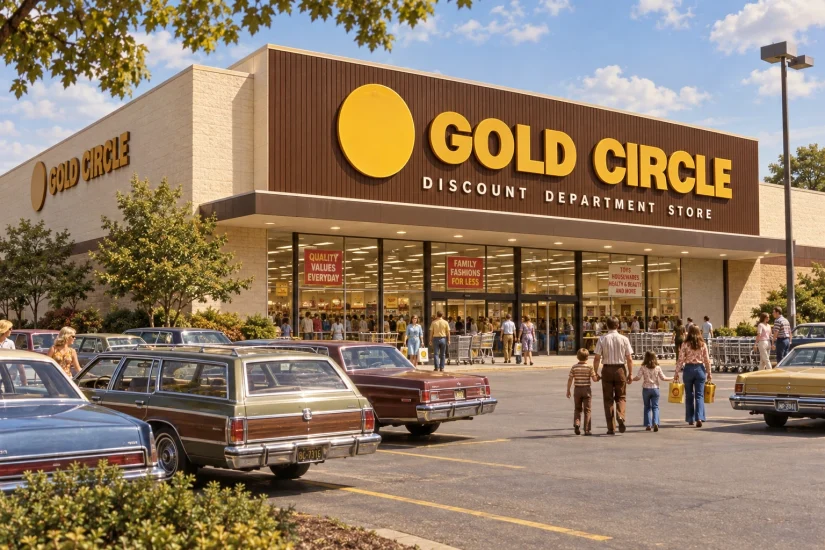
Gold Circle: Remembering Discount Shopping and Toy Aisles
Gold Circle brought clothing, toys, electronics, and household goods to Ohio shoppers beginning in 1967. Explore the Columbus-born discount chain’s growth, its connection to Federated Department Stores, and what happened when its familiar name disappeared in 1988.
OPENING
Gold Circle’s early stores offered more than clothing racks and toy aisles. Some also included substantial food departments.
A 1971 Federal Trade Commission record describes early Gold Circle stores as occupying approximately 120,000 square feet, with about 24,000 square feet devoted to food departments.
That detail reveals the scale of the shopping experience. Gold Circle aimed to bring several kinds of purchases together under one roof.
The chain is gone, but its story remains connected to Columbus and the growth of suburban discount shopping.
AT A GLANCE
Place: Gold Circle
Also known as: Gold Circle Discount Department Stores
Historical location: Founded in Columbus, Ohio; headquarters and distribution operations in Worthington, Ohio; expanded into other states
Category: Discount department stores
Opened/established: 1967
Closed/disappeared: Sold and dismantled in 1988, with store conversions following
Current status: The original chain no longer operates
Remembered for: Clothing, toys, electronics, housewares, seasonal merchandise, and its connection to later Hills stores
HOW IT BEGAN
Gold Circle began as a discount retail division of Federated Department Stores, the company associated with several established department-store names.
Federal Trade Commission records state that Federated opened its first two Gold Circle stores in Columbus in 1967. In 1969, it added three Dayton stores and another Columbus location.
The business developed a different shopping format from the traditional downtown department store. Large suburban locations combined broad merchandise selections with a focus on discount shopping.
Columbus remained central to the chain’s identity. Its headquarters and distribution center were located in nearby Worthington.
As Gold Circle expanded, it reached customers beyond Ohio, including communities in New York, Kentucky, and western Pennsylvania.
WHAT MADE IT SPECIAL
Gold Circle offered the variety that made discount department stores useful to families.
Its merchandise included clothing, footwear, toys, electronics, bedding, housewares, and seasonal goods. A shopping trip could cover school clothes, a household purchase, and a birthday present.
That range gave different members of a family different reasons to visit. The toy department appealed to children, while adults could compare practical purchases elsewhere in the store.
The early food departments added another dimension. The FTC record distinguishes between food operations run by Federated in Dayton and those operated by a third party in Columbus.
Gold Circle also became part of larger shopping developments. Reporting on Columbus’ retail history identifies it as an anchor at Southland, which opened in 1977.
These connections placed the chain within the broader shift toward suburban shopping centers. Gold Circle was both an individual store destination and part of the surrounding retail neighborhood.
THE FINAL CHAPTER
In 1986, Federated combined the administration of Gold Circle and another discount division, Richway. The two store names continued, while buying and other functions were consolidated.
A larger ownership change followed in 1988, when Campeau Corporation acquired Federated.
That September, a sale to Kimco Development Corporation was announced. Contemporary reporting described the transaction as part of Campeau’s financial restructuring.
The store properties moved into different retail futures. Kimco planned to lease 35 locations in Ohio, New York, and Kentucky to Hills Department Stores. Other properties were designated for additional operators.
Gold Circle’s liquidation ended its identity as a shopping chain, even where retail activity continued.
For customers, the transition could mean returning to a familiar location and finding a different name above the entrance.
WHAT’S THERE NOW?
Former Gold Circle stores have individual histories. Some became other department stores, while later changes brought additional tenants or redevelopment.
In Columbus, the Morse Road location provides a local example. Historical material identifies the former Gold Circle property with the building later used by the Franklin County Board of Elections.
Franklin County’s official building directory lists the Board of Elections Office at 1700 Morse Road, Columbus, Ohio. That address listing was checked on October 14, 2026.
The present county use does not mean the building retains its original retail layout or appearance.
Other former Gold Circle locations require separate address research. A chain-wide conversion history cannot establish what occupies every property today.
DO YOU REMEMBER GOLD CIRCLE?
Which Gold Circle did your family visit? Did you head for the toy department, browse electronics, or shop there for school clothes?
Share your memories with Forgotten Spots. Include the town, street, and approximate year if you remember them.
Photographs, shopping bags, catalogs, advertisements, receipts, and employee materials can help document the chain’s history. Please identify who owns submitted materials and whether they may be published.
SOURCES AND CREDITS
- Federal Trade Commission — 1971 Decision Records: Early Columbus and Dayton openings, store size, and food departments.
- UPI — “Campeau Corp. Sells Gold Circle Chain to Kimco Development Corp.”, September 7, 1988: Sale, restructuring, and planned Hills leases.
- Franklin County — Board of Elections Office: Current official address listing.
- Gold Circle — Historical Overview: Supplemental merchandise, headquarters, Richway consolidation, and former-store information.
- Axios Columbus — “What Happened to Columbus’ Directional Malls”: Gold Circle’s connection to Southland.