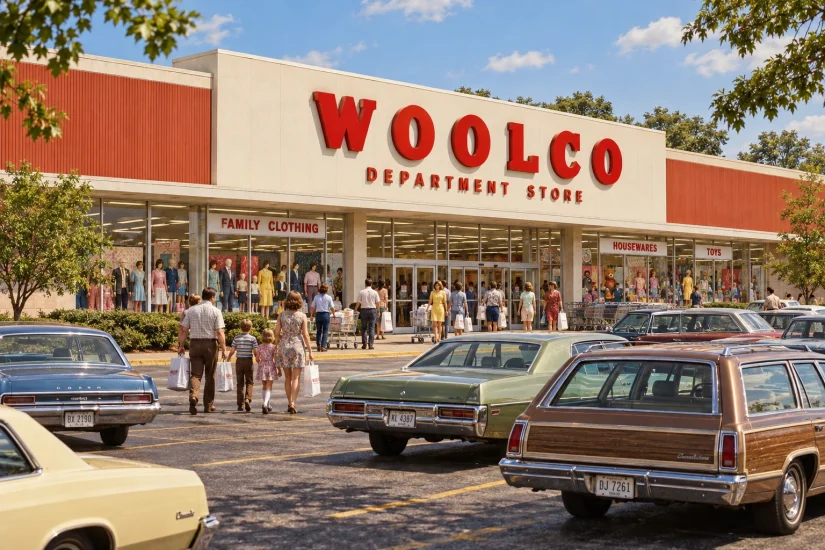
Woolco: Remembering Family Shopping and Discount Departments
Woolco brought Woolworth’s retail experience into larger discount stores beginning in Columbus in 1962. Explore its clothing and household departments, its expansion during the 1960s and 1970s, and the different endings of its American and Canadian operations.
OPENING
Woolco’s story began in Columbus, Ohio, in 1962.
The new stores carried a familiar retail name into a larger format. Woolworth had built its reputation through variety stores; Woolco offered spacious discount shopping with clothing, household merchandise, and other departments under one roof.
Its arrival marked a new chapter in the parent company’s history.
The American chain disappeared in 1983, but Canadian Woolco stores continued for another decade. Their later conversion helped launch Walmart’s Canadian business.
AT A GLANCE
Place: Woolco
Also known as: Woolco Department Stores
Historical location: First store in Columbus, Ohio; expanded across the United States and into Canada and the United Kingdom
Category: Discount department stores
Opened/established: 1962
Closed/disappeared: American stores closed by January 1983; Walmart acquired 122 Canadian stores in 1994
Current status: The original chain no longer operates
Remembered for: Family clothing, household goods, toys, broad departments, and its connection to Woolworth
HOW IT BEGAN
F. W. Woolworth Company introduced Woolco in 1962, opening its first store in Columbus.
The concept addressed a changing shopping market. Customers increasingly visited large suburban stores where they could browse several departments and park close to the entrance.
Woolco offered a larger discount-store format alongside Woolworth’s established variety-store business.
The distinction matters. Woolco and Woolworth shared a parent company, but they were separate store identities.
Expansion began quickly. The Woolworths Museum identifies Columbus, Ohio, and Hamilton, Ontario, as the locations of the first American and Canadian Woolco stores in 1962.
A surviving Columbus advertisement from October that year documents how the company introduced its new concept to local shoppers.
The chain subsequently expanded into additional markets, including the United Kingdom.
WHAT MADE IT SPECIAL
Woolco combined the practical appeal of a discount store with the breadth of a department store.
Clothing and household departments were central to the experience. Toys and other merchandise added reasons for different members of a family to browse.
A shopping trip could cover several needs without moving between separate specialty stores.
The larger format also distinguished Woolco from the older Woolworth five-and-dime. Its scale reflected the growing importance of suburban shopping centers during the 1960s and 1970s.
For Columbus, the chain has an especially direct historical connection: the city hosted the beginning of a retail concept that later reached customers far beyond Ohio.
Original advertisements provide a useful way to understand that era. They show how Woolco presented itself to shoppers at the time, rather than relying only on memories recorded decades later.
THE FINAL CHAPTER
The American Woolco business struggled financially.
In September 1982, Woolworth announced plans to close its 336 U.S. Woolco stores. Liquidation followed, and the American stores were shuttered by January 1983.
That decision ended Woolco’s U.S. operations, but it did not close the Woolworth variety-store chain at the same time. Woolworth continued operating American stores until 1997.
Canada followed a different path.
Its Woolco business survived the American shutdown. In 1994, Walmart acquired 122 Canadian Woolco stores from Woolworth and used them to enter the Canadian market.
Walmart’s official history confirms the purchase. The former Woolco network gave the company a substantial starting presence rather than requiring every location to be built from scratch.
These were distinct chapters: closure in the United States and acquisition of most Canadian locations years later.
WHAT’S THERE NOW?
Former Woolco properties have individual histories.
Some continued as retail locations under different names. Others were altered, divided among tenants, or redeveloped.
The 1994 Canadian acquisition provides a documented link between Woolco and Walmart. However, it does not establish that every acquired building remains a Walmart today.
Individual properties may have changed again through rebuilding or relocation.
For Columbus and other American cities, a confirmed street address is needed to establish whether a particular Woolco building survives and what occupies it now.
Historical sources and Walmart’s acquisition records were reviewed on October 15, 2026. Exact current uses of individual former Woolco properties were not independently verified.
Surviving advertisements, photographs, and shopping-center records remain valuable ways to trace the chain.
DO YOU REMEMBER WOOLCO?
Which Woolco did your family visit? Do you remember shopping for school clothes, browsing the toy department, or seeing the store change to another retailer?
Share your memories with Forgotten Spots. Include the town, street, and approximate year if you remember them.
Photographs, advertisements, shopping bags, receipts, employee materials, and store directories can help preserve this history. Please identify who owns submitted materials and whether they may be published.
SOURCES AND CREDITS
- The Woolworths Museum — A Brief History: The 1962 American and Canadian launches and broader company context.
- The Woolworths Museum — Columbus Woolco Advertisement: Contemporary promotional material from October 1962.
- Woolco — Historical Overview: Supplemental information about the American opening and closure chronology.
- The Washington Post — “Woolworth Will Shut Down All 336 Woolco Discount Stores”, September 25, 1982: Contemporary closure announcement.
- Walmart — History of Walmart International: Purchase of 122 Canadian Woolco stores in 1994.
- Library of Congress — Woolworth’s Five and Dime: Separate chronology of the American Woolworth variety stores.