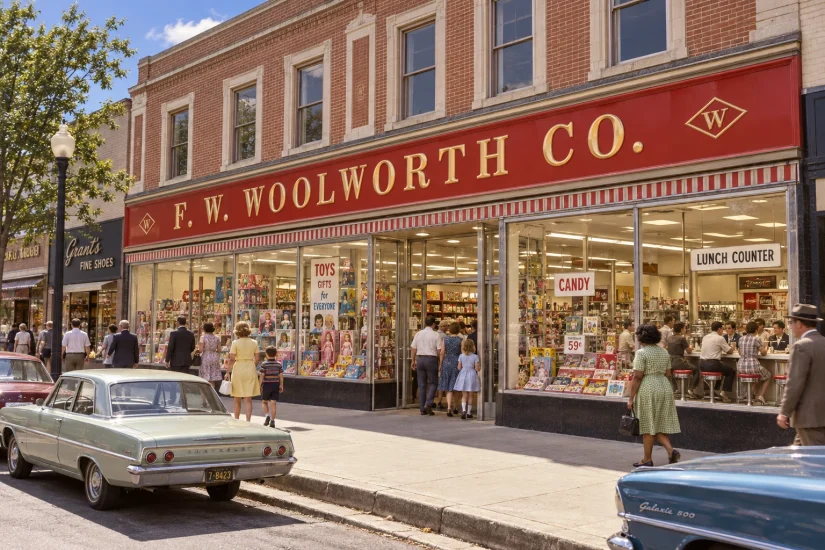
F. W. Woolworth: Remembering Lunch Counters and Five-and-Dime Shopping
F. W. Woolworth brought candy, inexpensive toys, household necessities, and lunch-counter meals to generations of shoppers. Explore its successful Lancaster beginnings, its place in everyday life during the 1960s and 1970s, and the history preserved after its American stores closed.
OPENING
At Woolworth, a shopping trip could include a small purchase and a seat at the lunch counter.
Candy, toys, sewing supplies, and household basics made the five-and-dime a familiar destination. Its lunch counters offered another reason to stay.
However, those counters also hold an important civil rights history. In Greensboro, North Carolina, four Black college students challenged segregated service in 1960, helping inspire a wider protest movement.
The original American Woolworth variety-store chain disappeared in 1997. Its legacy includes both everyday shopping memories and events that changed the country.
AT A GLANCE
Place: F. W. Woolworth
Also known as: Woolworth’s; Woolworth; the five-and-dime; the five-and-ten
Historical location: First attempted store in Utica, New York; first successful store in Lancaster, Pennsylvania; later expanded nationwide and internationally
Category: Variety stores and five-and-dime retail
Opened/established: 1879
Closed/disappeared: The remaining American Woolworth variety stores closed in 1997
Current status: The original U.S. chain no longer operates; some former buildings and lunch-counter artifacts survive
Remembered for: Candy, inexpensive toys, household goods, lunch counters, and its role in civil rights history
HOW IT BEGAN
Frank Winfield Woolworth began experimenting with a simple retail idea: offer inexpensive merchandise at clearly established prices.
His first store opened in Utica, New York, in 1879, but it failed.
He tried again that year in Lancaster, Pennsylvania. This second store succeeded and became the foundation for a much larger business.
As the selection expanded to include ten-cent merchandise, the five-and-ten format developed into a recognizable shopping institution.
Customers could browse affordable goods without entering a large, traditional department store. Small purchases became the basis of a substantial retail business.
By the 1960s and 1970s, Woolworth’s history already stretched back generations. Its stores connected older downtown shopping traditions with the changing habits of postwar consumers.
WHAT MADE IT SPECIAL
Woolworth offered a wide assortment of small, practical purchases.
A shopper might visit for candy, an inexpensive toy, or a household necessity. Seasonal displays added reasons to browse, while the variety-store format brought different categories together.
The phrase “five-and-dime” survived even after prices rose beyond nickels and dimes. It described a familiar kind of store as much as a price point.
Lunch counters added another dimension to the experience.
They made it possible to combine errands with a sandwich, a drink, or a short break. For many customers, the counter was as memorable as the merchandise.
That history also requires acknowledging who was denied equal service.
On February 1, 1960, four students from North Carolina Agricultural and Technical College sat at the segregated Woolworth lunch counter in Greensboro and requested service.
They were Ezell Blair Jr., later known as Jibreel Khazan; Franklin McCain; Joseph McNeil; and David Richmond.
Their action helped inspire sit-ins elsewhere. The Greensboro counter became a national symbol of the struggle against segregation.
Remembering Woolworth means preserving both the ordinary shopping experience and this consequential chapter.
THE FINAL CHAPTER
Woolworth faced increasing competition from other discount retailers as shopping habits changed.
The traditional variety-store business became less central to the company’s future. Store closures reduced its American presence before the final decision arrived.
In 1997, the company ended its remaining U.S. Woolworth variety-store operations.
The closure ended the familiar American store format, but the corporation continued through other businesses.
According to the Library of Congress, Woolworth Corporation became Venator Group in 1998, then adopted the Foot Locker name in 2001 as it concentrated on athletic retail.
Those corporate developments were separate from the survival of individual Woolworth buildings. A former storefront might continue serving its community under an entirely different use.
WHAT’S THERE NOW?
One of the most significant surviving locations is the former Greensboro store at 134 South Elm Street, Greensboro, North Carolina.
It now houses the International Civil Rights Center & Museum, which preserves the site’s connection to the sit-in movement.
The museum’s official website advertises tours and lists that address. Its online visitor information was checked on October 15, 2026.
A section of the Greensboro lunch counter is also preserved at the Smithsonian’s National Museum of American History in Washington, D.C.
The Smithsonian identifies the counter and stools as part of its continuing public display.
Other former Woolworth stores have individual histories. Their current uses, surviving architectural details, and condition require research using a confirmed street address.
DO YOU REMEMBER WOOLWORTH’S?
Did you visit Woolworth for candy, toys, or a meal at the lunch counter? Do you remember a particular purchase or the location of your hometown store?
Share your memories with Forgotten Spots. Include the town, street, and approximate year if you remember them.
Photographs, menus, advertisements, receipts, shopping bags, and employee materials can help preserve this history. Accounts that document unequal treatment or local civil rights activity are also valuable.
Please identify who owns submitted materials and whether they may be published.
SOURCES AND CREDITS
- Library of Congress — Woolworth’s Five and Dime: Early stores, expansion, American closures, and corporate name changes.
- Smithsonian National Museum of American History — Greensboro Lunch Counter: The sit-in, segregation, and preservation of the counter.
- Smithsonian — Greensboro Lunch Counter Exhibition: Continuing museum display.
- International Civil Rights Center & Museum: Current museum identity, visitor information, and Greensboro address.
- The Woolworths Museum — Candy at Woolworth’s Five-and-Ten: Historical American candy retailing and displays.
- Congressional Record — July 21, 1997: Contemporary reflections on the American chain’s closing.