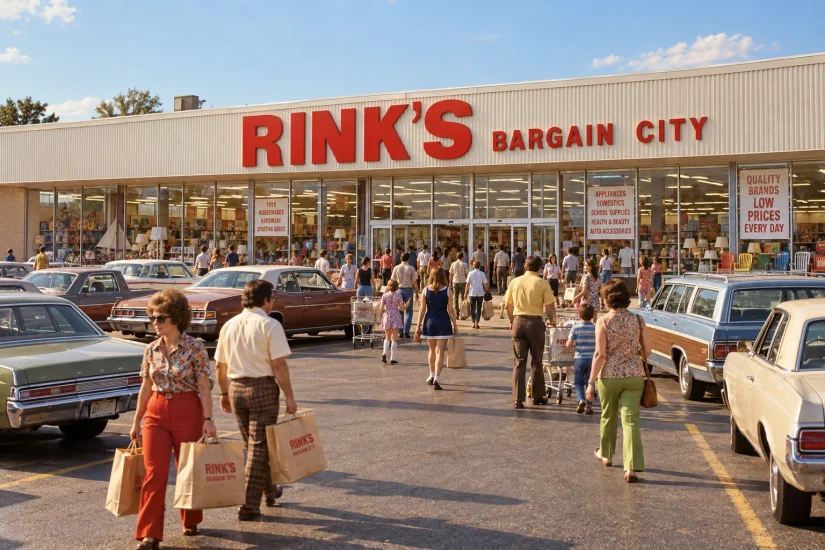
Rink’s Bargain City: Remembering Discount Shopping in
Rink’s Bargain City connected two Ohio retail histories under one familiar name. Explore its Hamilton-area beginnings, connection to Toledo’s Bargain City, and eventual place in Cook United’s discount-store business.
OPENING
The Rink’s name had an unusually fitting beginning: a former skating rink.
Retail historian Mall Hall of Fame traces the business to Coleman and Hyman Ullner, who converted a vacant rink near Hamilton, Ohio, into a store selling discounted surplus merchandise.
From that practical beginning came a regional shopping name that would eventually join forces with another Ohio retailer.
Rink’s Bargain City is gone. Its history survives through advertisements, photographs, and the complicated trail of store names left by mergers and acquisitions.
AT A GLANCE
Place: Rink’s Bargain City
Also known as: Rink’s; Rink’s Discount Department Stores
Historical location: Hamilton and Cincinnati area, with a later connection to Toledo’s Bargain City chain
Category: Discount department stores
Opened/established: Rink’s began in the early 1950s; the combined Rink’s Bargain City identity appeared in the early 1970s
Closed/disappeared: Locations closed or changed names during the 1980s; parent Cook United entered liquidation in 1987
Current status: Defunct regional retail identity
Remembered for: General merchandise, discount prices, and large-store shopping
HOW IT BEGAN
The Rink’s Bargain City story has two starting points.
One was the Ullners’ Hamilton-area business, which expanded from surplus merchandise into general retailing. Published histories differ on whether its opening belongs to 1951 or 1952.
The other was Toledo’s Bargain Barn, established by Hyman Swolsky and later known as Bargain City.
Gray Drug acquired Rink’s in 1964 and Bargain City in 1967. The two operations eventually shared the Rink’s Bargain City name, which retail histories place in use by late 1971.
Gray’s involvement explains why a discount department-store chain appears in the history of a major drugstore company. Its business interests extended beyond traditional pharmacies.
WHAT MADE IT SPECIAL
Rink’s belonged to the generation of regional retailers that made broad selections and discount prices part of the same shopping trip.
Its growth from surplus sales to general merchandise reflected a larger change in the business. A bargain store could become a destination for a much wider range of household purchases.
Mall Hall of Fame describes Rink’s stores ranging from approximately 40,000 to 90,000 square feet during its earlier expansion. Some locations also had an adjacent supermarket.
That arrangement added convenience: general merchandise and grocery shopping could share a destination.
The local name mattered as well. Looking back at Rink’s means looking at Ohio businesses that developed before today’s national retail landscape took shape.
For former customers and employees, the most useful memories are specific ones. A store address, department, purchase, or year can help turn nostalgia into a clearer historical record.
THE FINAL CHAPTER
A major ownership change arrived in 1981.
According to the Encyclopedia of Cleveland History, Gray Drug sold its 47 Rink’s stores to Cook United so it could concentrate on its drugstore business.
Rink’s then became part of the organization behind other regional names, including Ontario and Uncle Bill’s.
However, Cook United was struggling. Its company history records continuing losses, Chapter 11 filings in 1984 and 1987, and conversion to Chapter 7 liquidation in November 1987.
There was no single closing day for every Rink’s location. Stores closed in stages, while some continued temporarily under another name.
Historical accounts of Ontario document that process. Some Ontario stores became Rink’s after the 1981 acquisition, while later restructuring brought further closures and conversions to Cooks.
WHAT’S THERE NOW?
Rink’s Bargain City was a chain, so its former properties require individual research.
This article does not verify current occupants, building conditions, or surviving signs at specific locations. A later store at the same address does not necessarily mean the original Rink’s building remains.
To investigate a branch, begin with a confirmed street address. Newspaper advertisements, city directories, dated photographs, and property records can help trace what followed.
The ownership timeline provides another clue. A remembered Rink’s location may appear under Ontario or Cooks in records from a different year.
DO YOU REMEMBER RINK’S BARGAIN CITY?
Which Rink’s location did your family visit? Do you remember its original sign—or seeing the store change names?
Share your memories with Forgotten Spots. Include the town, approximate year, and nearby streets when possible.
Photographs, advertisements, receipts, shopping bags, and employee materials are welcome. Please identify their owner and whether permission for publication is available.
SOURCES AND CREDITS
- Mall Hall of Fame — Rink’s / Bargain Barn: Origins, store format, and the combined retail identity.
- Encyclopedia of Cleveland History — Gray Drug Stores, Inc.: Acquisition of Rink’s and the 1981 sale to Cook United.
- Encyclopedia of Cleveland History — Cook United, Inc.: Corporate financial troubles and liquidation.
- Ontario department-store history: Supplemental chronology of conversions and closures.
- List of Defunct Department Stores — Ohio: Supplemental information about the separate Rink’s and Bargain City origins.