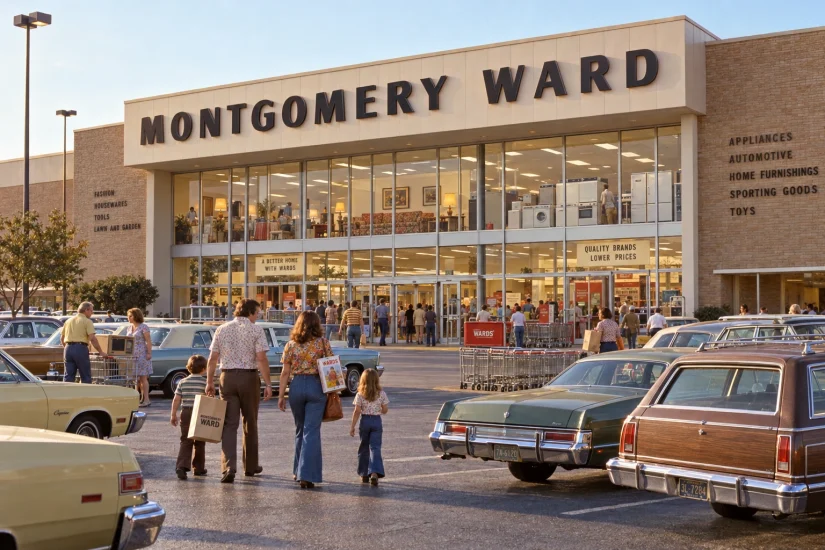
Montgomery Ward: Remembering Catalogs and “Monkey Wards”
Montgomery Ward connected American households with catalogs, clothing, appliances, tools, and department-store shopping. Explore its Chicago beginnings, its familiar “Monkey Wards” nickname, and the difference between the original chain and today’s revived retail name.
OPENING
Montgomery Ward’s first catalog was a single sheet offering 163 items.
Issued in 1872, it was a modest beginning for a business that would eventually send enormous catalogs into American homes. By the 1960s and 1970s, shoppers could browse its pages or visit a department store carrying the same familiar name.
Many called it “Monkey Wards.”
The original department-store chain is gone. However, its story continues through surviving merchandise, family memories, and a later business that revived the Montgomery Ward name.
AT A GLANCE
Place: Montgomery Ward
Also known as: Wards; “Monkey Wards”
Historical location: Founded in Chicago, Illinois; expanded nationwide
Category: Mail-order catalogs and department stores
Opened/established: 1872; major retail-store expansion began in 1926
Closed/disappeared: Original catalog operation ended in 1985; original department-store chain closed in 2001
Current status: Original chain defunct; a later catalog and online retailer operates under the Montgomery Ward name
Remembered for: Catalogs, appliances, tools, clothing, home merchandise, and family shopping trips
HOW IT BEGAN
Aaron Montgomery Ward established his business in Chicago in 1872.
His catalog helped customers, particularly those in rural communities, buy goods without relying entirely on nearby merchants. Customers could compare products and place orders from home.
The Chicago History Museum records rapid growth. Within a few years, the original sheet had become a catalog with thousands of items.
During the 1920s, Montgomery Ward expanded into retail stores. Its business now offered two ways to shop: ordering through the catalog or browsing merchandise in person.
WHAT MADE IT SPECIAL
During the 1960s and 1970s, Montgomery Ward combined the reach of mail order with the appeal of department-store shopping.
The Made-in-Chicago Museum describes a period of new suburban stores and substantial catalog production. Alongside major seasonal editions, Wards produced specialized catalogs covering subjects such as automotive goods, toys, photography, and power tools.
That range made the business relevant to different interests and household needs. A clothing purchase and a search for home equipment could begin with the same retailer.
Its product lines also developed familiar identities. Names such as Powr-Kraft became associated with Wards tools, while appliances formed another important part of the shopping experience.
The personal connections extended beyond purchases.
In a reader comment on the Chicago History Museum’s catalog history, Ann Bennett-Beals described several family members working for Wards in retail, repair, accounting, and catalog operations. Her account shows how one company could become part of a family’s working life across generations.
Such recollections add something that sales figures cannot: the people behind the counters, service departments, and deliveries.
THE FINAL CHAPTER
Montgomery Ward ended its original catalog operation in 1985. Its stores continued, while management tried to reshape the business around merchandise departments and specialty retailing.
Those changes produced periods of improvement, but they did not secure the chain’s future.
On December 28, 2000, the company announced that it would close its remaining 250 stores and distribution operations. Closing sales followed in 2001.
Contemporary reporting described a retailer struggling after disappointing holiday sales. For employees and customers, the announcement brought an end to the original chain’s long history.
Former stores then followed separate paths. Their later occupants, renovations, or demolition dates depend on the individual property.
WHAT’S THERE NOW?
The Montgomery Ward name still appears online and in catalogs.
This is a later retail business rather than the uninterrupted survival of the old department-store chain. Its official website states that Colony Brands acquired the brand in 2008 and continues to offer merchandise through catalogs and online shopping.
That advertised business status was checked through the official website on October 16, 2026.
The original stores require a different kind of research. A remembered mall entrance or former freestanding location should be traced through a confirmed address.
This article does not verify current occupants or building conditions at individual former stores.
DO YOU REMEMBER MONTGOMERY WARD?
Did your family call it “Monkey Wards”? Do you remember browsing the catalog, shopping for clothes, or buying an appliance or tool there?
Share your memories with Forgotten Spots. Include the community, store location, and approximate year when possible.
Catalogs, photographs, receipts, advertisements, and employee materials can help preserve the history. Please identify who owns submitted items and whether permission for publication is available.
SOURCES AND CREDITS
- Chicago History Museum — Montgomery Ward’s First Catalog: Early catalogs, founder, historical development, and attributed reader recollections.
- Made-in-Chicago Museum — Montgomery Ward & Co.: Midcentury stores, catalogs, merchandise, and later restructuring.
- UPI — Montgomery Ward Dropping Catalog: Contemporary reporting on the original catalog operation’s ending.
- UPI — Montgomery Wards Closing Stores: December 2000 shutdown announcement.
- Montgomery Ward — About Us: Current brand ownership and advertised catalog and online operations.
- Montgomery Ward — Historical Overview: Supplemental chronology and distinction between the original and later businesses.