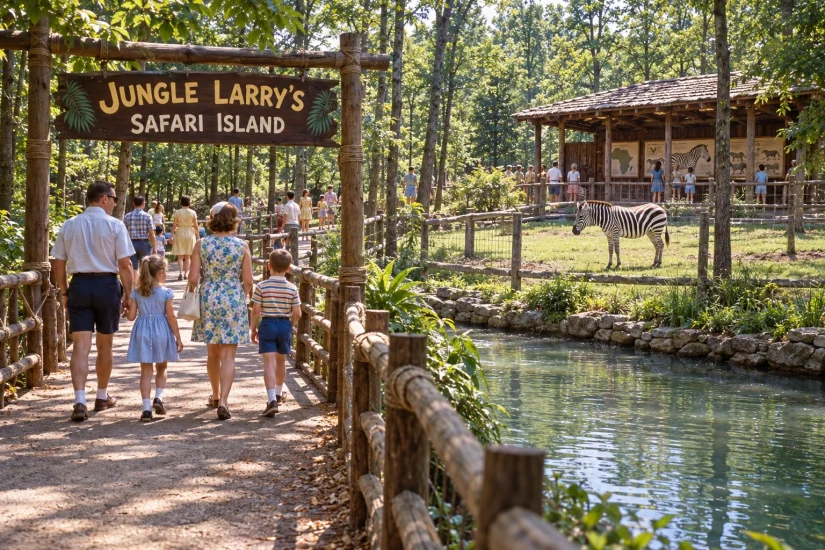
Jungle Larry’s Safari Island: Remembering Wildlife Encounters in Sandusky, Ohio
Jungle Larry’s Safari Island brought animal exhibits and educational presentations to Cedar Point in Sandusky, Ohio. Explore its 1960s beginnings, the family behind the attraction, and its closing after the 1994 season.
OPENING
Safari Island began as an actual island.
The Tetzlaff family’s history describes animals being transported across the water by raft during its first season. The wooded setting became home to an attraction offering something different from Cedar Point’s rides.
Safari Island is gone, but its story remains connected to two familiar names: Jungle Larry and Safari Jane.
AT A GLANCE
Place: Jungle Larry’s Safari Island
Also known as: Jungle Larry’s Safari; Jungle Larry’s African Safari
Historical location: Inside Cedar Point amusement park, Sandusky, Ohio
Category: Animal attractions and amusement-park entertainment
Opened/established: Safari Island opened in 1965, following a smaller Cedar Point animal exhibit in 1964
Closed/disappeared: After the 1994 season
Current status: Attraction closed; Cedar Point remains an operating amusement park
Remembered for: Animal exhibits, educational presentations, Jungle Larry, Safari Jane, and its wooded island setting
HOW IT BEGAN
Lawrence Tetzlaff, known professionally as Jungle Larry, worked with his wife and partner, Nancy Jane Tetzlaff, known as Safari Jane.
Before Safari Island, their work included animal presentations and television appearances. Sandusky Library’s history notes Larry’s appearances on Cleveland programs, including Captain Penny.
In 1964, the family established an animal exhibit at Cedar Point. The following year, the attraction moved into the lagoon area as Safari Island.
For visitors who recognized Larry from television, the park offered an opportunity to see his work in person.
WHAT MADE IT SPECIAL
Safari Island combined animal viewing with presentations.
The family’s account lists animals such as zebras, lions, elephants, leopards, pythons, and tigers among those exhibited over the years. Educational programs helped give the attraction an identity beyond its enclosures.
Its wooded surroundings also distinguished it from the surrounding midway. As Cedar Point developed, the canals were filled and the attraction’s setting changed.
The emphasis on explaining animals became part of the Tetzlaffs’ wider work.
Naples Zoo’s official history describes their use of film and living animals to introduce audiences to wildlife and conservation. Their presentations reached schools as well as leisure attractions.
In 1969, they began exhibiting animals at Caribbean Gardens in Naples, Florida. The Ohio and Florida operations then formed overlapping chapters of the family’s history.
That connection helps explain why memories of Jungle Larry extend beyond Cedar Point.
THE FINAL CHAPTER
Larry Tetzlaff died in February 1984.
His death did not immediately end the Cedar Point attraction. Safari Jane and other family members continued operating it through the 1994 season.
The family’s history explains that Naples had grown enough to support the Florida operation independently. They decided to concentrate their efforts there.
Safari Island’s closing therefore marked the end of its Cedar Point chapter, while the family’s work continued elsewhere.
Remembering Safari Jane’s role is essential to that history. Naples Zoo records her partnership with Larry and the family’s continuation of educational programs after his death.
WHAT’S THERE NOW?
The Tetzlaff family’s historical account identifies Power Tower’s location at Cedar Point as the former Safari Island site.
Cedar Point’s official website currently lists Power Tower as an attraction, and its published timeline dates the ride’s debut to 1998.
These online references were checked on October 18, 2026. No physical inspection or detailed survey of surviving Safari Island structures was performed.
A separate connection survives in Florida. Naples Zoo’s official history preserves the Tetzlaffs’ role in developing its animal exhibits and educational programs.
That is a continuation of their broader legacy, rather than a surviving Safari Island at Cedar Point.
DO YOU REMEMBER JUNGLE LARRY’S SAFARI ISLAND?
Did you recognize Jungle Larry from television before visiting Cedar Point? Which animal or presentation do you remember most?
Share your memories with Forgotten Spots. Include the approximate year and whether Larry, Safari Jane, or another presenter appeared during your visit.
Photographs, brochures, maps, postcards, and employee materials are welcome. Please identify who owns submitted items and whether permission for publication is available.
SOURCES AND CREDITS
- Jungle Larry & Safari Jane — Cedar Point: Family account of the attraction’s development, setting, closure, and former site.
- Sandusky Library — Jungle Larry at Cedar Point: Television appearances, Cedar Point beginnings, Larry’s death, and continued family operation.
- Naples Zoo — History: The Tetzlaffs’ partnership, educational work, and Florida connection.
- Cedar Point — Power Tower: Current attraction listing.
- Cedar Point — Timeline, 1970–1999: Power Tower’s 1998 debut.