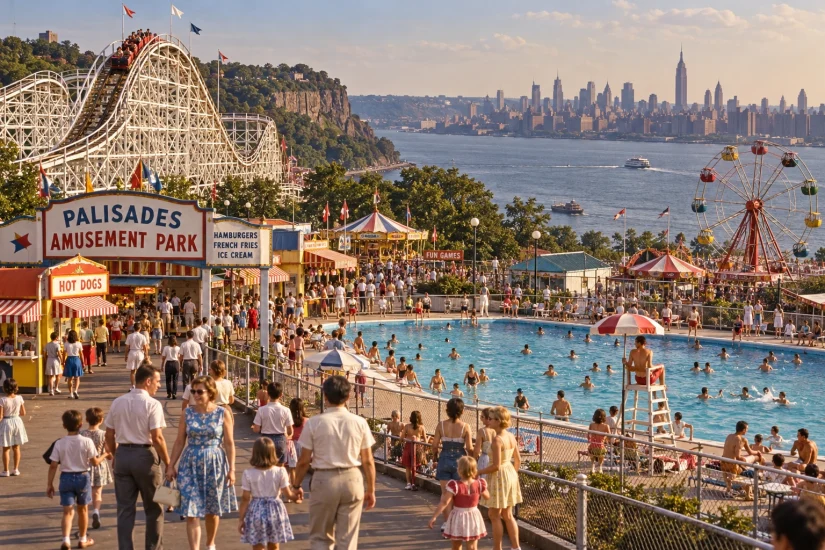
Palisades Amusement Park: Remembering the Pool and Famous Jingle in Cliffside Park and Fort Lee, New Jersey
Palisades Amusement Park combined roller coasters, swimming, entertainment, and memorable advertising above the Hudson River. Explore its beginnings, its midcentury popularity, and the residential development that replaced it after 1971.
OPENING
For many people, remembering Palisades Amusement Park begins with a tune.
The advertising jingle “Come On Over” reached radio and television audiences during the 1960s. Songwriter Gladys Shelley wrote its words and music, and Steve Clayton performed it.
The invitation outlived the destination. Palisades closed on September 12, 1971, but its music remains part of the park’s recorded history.
AT A GLANCE
Place: Palisades Amusement Park
Also known as: The Park on the Palisades; Palisade Amusement Park
Historical location: Along Palisade Avenue, spanning Cliffside Park and Fort Lee, New Jersey
Category: Amusement parks and swimming attractions
Opened/established: 1898
Closed/disappeared: September 12, 1971
Current status: Amusement park demolished; residential towers occupy the former grounds
Remembered for: The Cyclone, enormous saltwater pool, entertainment, French fries, and advertising jingles
HOW IT BEGAN
Palisades began in 1898 as a trolley-company attraction.
Its purpose was practical: give passengers a reason to travel on weekends. A picnic destination gradually became an amusement park.
Brothers Nicholas and Joseph Schenck took over in 1910 and expanded the attractions. Their additions included the outdoor saltwater swimming pool.
During the 1930s, brothers Irving and Jack Rosenthal assumed control. Their years shaped the park familiar to many visitors of the 1940s through the 1960s.
WHAT MADE IT SPECIAL
Palisades offered several kinds of recreation within its relatively compact grounds.
The Cyclone provided wooden-coaster excitement. The Tunnel of Love and other attractions offered different experiences. Meanwhile, the pool gave visitors another reason to spend a summer day there.
Advertisements called it the world’s largest outdoor saltwater pool. That claim belongs to the park’s promotional history; the historical society notes that published dimensions remain unverified.
Food became part of the memory, too. The historical society documents the association between Palisades and its vinegar-flavored French fries.
Music helped carry the park’s identity beyond its gates. Its sound archive preserves jingles, radio advertisements, and recordings connected with park entertainment.
The “Come On Over” commercial was separate from Freddy Cannon’s 1962 hit “Palisades Park.” The song helped give the destination national recognition, while advertising repeatedly invited local audiences to visit.
These surviving recordings are historical evidence in their own right. They preserve the voices and sales pitches that accompanied the rides and summer outings.
THE FINAL CHAPTER
Palisades’ valuable location became central to its ending.
Roller Coaster DataBase describes traffic and parking pressures surrounding the popular park. In 1967, Cliffside Park rezoned the land for high-rise development.
Irving Rosenthal eventually sold the property to Winston-Centex. The developer leased it back for one final season.
The park closed on September 12, 1971. Its rides were dismantled or sold, and its buildings gave way to redevelopment.
The ending changed the site’s purpose completely: a place associated with crowds arriving for the day became a residential neighborhood.
WHAT’S THERE NOW?
Residential towers replaced the amusement park.
The Palisades Amusement Park Historical Society identifies the Buckingham, Winston Towers, and Carlyle Towers across the former grounds.
It also documents the Little Park of Memories, a commemorative space in front of Winston Towers Building 300. Donations from former visitors and supporters helped fund the memorial.
These online historical descriptions were reviewed on October 18, 2026. No physical inspection was performed, and current memorial access conditions were not independently confirmed.
Visitors seeking the old park should expect a developed residential setting. Its story is now easier to trace through photographs, maps, recordings, and the memorial than through surviving rides.
DO YOU REMEMBER PALISADES AMUSEMENT PARK?
Do you remember the pool, the Cyclone, or hearing the jingle before a family visit? Did you attend a performance or have a favorite midway food?
Share your memories with Forgotten Spots. Include the approximate year and attraction when possible.
Photographs, tickets, maps, advertisements, matchbooks, and employee materials are welcome. Please identify their owner and whether permission for publication is available.
SOURCES AND CREDITS
- Palisades Amusement Park Historical Society — History: Origins, owners, and major attractions.
- Historical Society — Sounds and Music: Jingle credits, radio advertisements, and musical recordings.
- Historical Society — Frequently Asked Questions: Names, location, pool advertising, closing, and redevelopment.
- Historical Society — Little Park of Memories: Memorial location and fundraising.
- Roller Coaster DataBase — Palisades Amusement Park: Ownership, rides, and redevelopment context.
- Palisades Amusement Park — Historical Overview: Supplemental closing and redevelopment chronology.