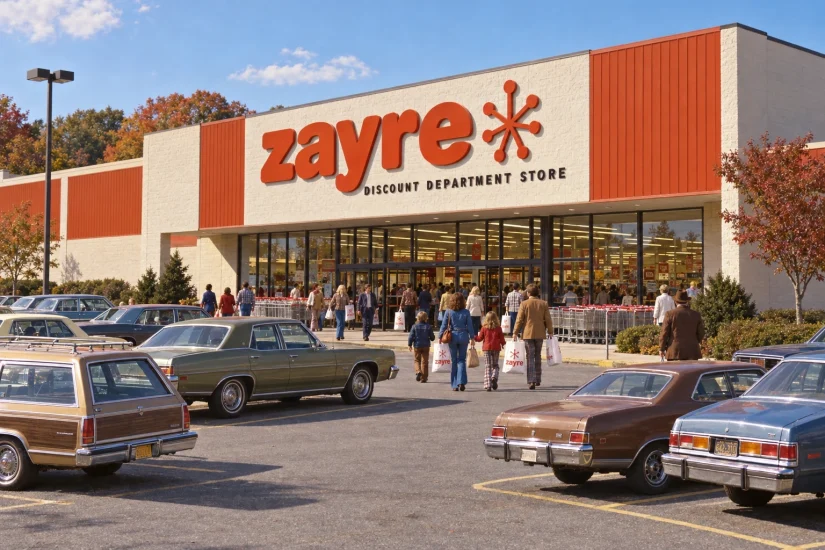
Zayre: Remembering Bargain Shopping and Busy Departments
Zayre grew from a Massachusetts discount store into a familiar shopping destination across much of the eastern United States. Explore its beginnings, broad merchandise selection, and the corporate changes that replaced its signs with Ames.
OPENING
Zayre’s story has an unexpected connection to a retailer shoppers still recognize: T.J. Maxx.
During the 1970s, Zayre’s parent company helped launch the new off-price business. However, the original Zayre stores followed a different path. They were eventually sold to Ames, and their familiar name disappeared.
Before those changes, Zayre offered a broad selection of affordable merchandise. Clothing, toys, electronics, and household goods brought shoppers into departments filled with everyday purchases and seasonal possibilities.
Its history connects the discount shopping boom of the 1960s and 1970s with a much larger transformation in American retail.
AT A GLANCE
Place: Zayre
Also known as: Zayre Department Stores; commonly remembered by shoppers as “Zayre’s”
Historical location: First store in Hyannis, Massachusetts; corporate headquarters in Framingham, Massachusetts; expanded across the eastern United States
Category: Discount department stores
Opened/established: 1956, with family business roots dating to 1919
Closed/disappeared: Stores sold to Ames in 1988; conversions and closures eliminated the Zayre name by 1990
Current status: The original store chain no longer operates; its parent company’s history continues through TJX
Remembered for: Bargain shopping, clothing, toys, household goods, electronics, and distinctive advertising
HOW IT BEGAN
Zayre’s roots reach back to Max and Morris Feldberg, brothers who built a business in Massachusetts after immigrating to the United States.
In 1919, they established the New England Trading Company, a wholesale hosiery business. Retail shops followed, laying the groundwork for a larger move into discount shopping.
The first Zayre store opened in Hyannis, Massachusetts, in 1956.
The Immigrant Learning Center traces the name to a phonetic English spelling of a Yiddish word meaning “very,” as in “very good.”
The format reflected a changing market. Self-service shopping and suburban locations offered an alternative to traditional downtown department stores.
During the following decades, Zayre expanded beyond New England and became a recognizable name in many communities.
WHAT MADE IT SPECIAL
Zayre combined several kinds of shopping in one place.
Its merchandise included clothing, footwear, bedding, toys, electronics, and housewares. A family could shop for practical needs while also browsing gifts and seasonal items.
That variety helped make the store appealing to different generations. Children had reasons to explore the toy department, while adults could compare clothing and household purchases.
Its advertising promoted the same broad appeal. The name, signs, and sale messages helped establish a recognizable identity in the competitive discount market.
Another important development took place behind the scenes.
In 1976, Zayre recruited retail executive Bernard “Ben” Cammarata to develop a new off-price chain focused on family apparel and home fashions.
The first T.J. Maxx stores opened in Auburn and Worcester, Massachusetts, in 1977.
This was a separate retail concept within the larger business. It became a lasting part of Zayre’s corporate legacy even as the original discount stores faced a different future.
THE FINAL CHAPTER
In October 1988, Ames completed its acquisition of Zayre’s discount store division.
The sale transferred the stores to another established discount retailer. Over time, familiar Zayre signs gave way to Ames branding.
Contemporary UPI reporting documented a major stage of that process in October 1989, when Ames converted 254 former Zayre stores.
Other locations closed or retained the old name temporarily. By 1990, Zayre had disappeared as an operating store brand.
Meanwhile, the former parent company underwent its own restructuring.
TJX’s official history explains that it became the successor company following Zayre’s 1989 reorganization. Its initial retail banners included T.J. Maxx, Hit or Miss, and Chadwick’s of Boston.
The distinction matters: Zayre’s stores went to Ames, while another part of the corporate business developed into TJX.
WHAT’S THERE NOW?
Former Zayre properties have individual histories.
Some continued as Ames stores before undergoing later changes. Others were divided among new tenants, redeveloped, or demolished.
Because this story covers the chain, there is no single current business that represents every former location.
A confirmed street address is needed to establish what happened to a particular store and whether its original building survives.
The clearest continuing corporate connection is TJX. Its official history, reviewed on October 14, 2026, documents the relationship between Zayre and the businesses that followed.
That corporate connection does not establish the present condition of individual former Zayre buildings. Those properties require separate research.
DO YOU REMEMBER ZAYRE?
Which Zayre did your family visit? Do you remember shopping for school clothes, browsing the toy department, or seeing your store change to Ames?
Share your memories with Forgotten Spots. Include the town, street, and approximate year if you remember them.
Old photographs, advertisements, shopping bags, receipts, employee materials, and store directories can help preserve this history. Please identify who owns submitted materials and whether they may be published.
SOURCES AND CREDITS
- The Immigrant Learning Center — Max and Morris Feldberg: Family business origins, discount-store development, and the Zayre name.
- The TJX Companies — Official History: T.J. Maxx’s launch and the corporate restructuring that followed.
- UPI — “Ames Completes Zayre Store Acquisition”, October 28, 1988: Completion of the store acquisition.
- UPI — “Ames Converts 254 Zayre Stores”, October 26, 1989: Store conversions.
- Zayre — Historical Overview: Supplemental merchandise, headquarters, and store-brand chronology.