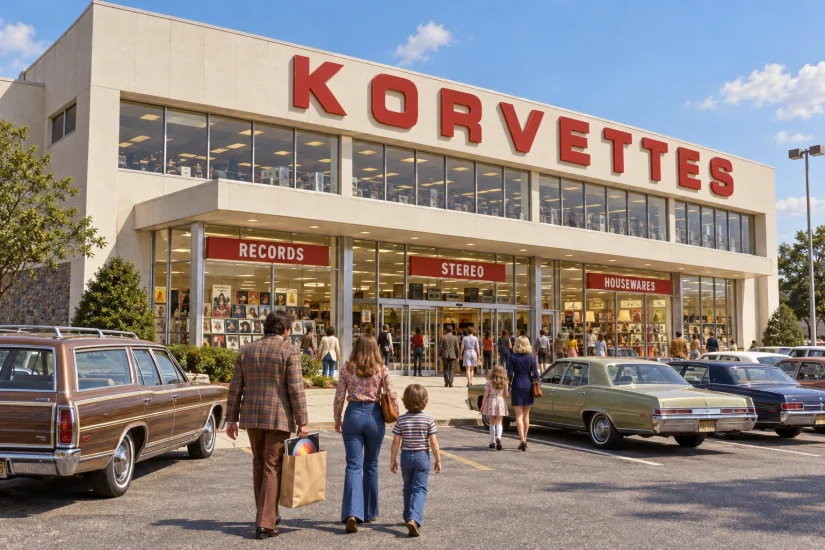
Korvettes: Remembering Record Bins and Stereo Shopping
E. J. Korvette, widely remembered as Korvettes, helped establish discount department-store shopping after World War II. Explore its New York beginnings, memorable record and stereo departments, and the changes that ended the chain in 1980.
OPENING
For music shoppers, Korvettes offered two connected attractions: records to bring home and stereo equipment to play them.
The chain’s audio business extended beyond familiar manufacturers. Korvettes also sold equipment under its own XAM brand, including amplifiers, receivers, and speakers.
Those departments helped distinguish a retailer that also sold clothing, appliances, and household merchandise.
The stores disappeared in 1980. Yet their place in music-shopping history remains a distinctive part of the Korvettes story.
AT A GLANCE
Place: E. J. Korvette
Also known as: Korvettes; Korvette’s; E. J. Korvette’s
Historical location: Founded in New York City; expanded into suburban markets and other parts of the eastern United States
Category: Discount department stores
Opened/established: 1948
Closed/disappeared: 1980; the final 17 stores closed in December
Current status: The original chain no longer operates
Remembered for: Discount merchandise, record departments, stereo equipment, XAM electronics, and suburban shopping
HOW IT BEGAN
Eugene Ferkauf established the business in New York City in 1948, working with his friend and business associate Joe Zwillenberg.
The operation began with luggage sold at reduced prices. Small appliances and other merchandise followed as the business grew.
The American Business History Center describes Ferkauf’s approach as selling larger quantities at smaller markups. That idea helped the business move from modest premises into increasingly large stores.
Expansion eventually brought Korvettes into suburban shopping centers.
One documented milestone came on September 18, 1962, when the first section of Pennsylvania’s King of Prussia Plaza opened.
According to the King of Prussia Historical Society, that development included a two-story, 172,000-square-foot Korvette department store with air-conditioning and escalators.
It was a striking change in scale from the company’s small beginnings.
WHAT MADE IT SPECIAL
Korvettes combined broad discount shopping with departments that could become destinations in their own right.
Its record selection appealed to customers looking for albums and singles, while its audio departments offered equipment for listening at home.
A history published by the Digital Research Library of Illinois History Journal includes a personal recollection of the Morton Grove, Illinois, store.
The writer remembers ordering records and sheet music through its music department and receiving them quickly. That account describes one customer’s experience at a particular branch, rather than a verified chain-wide service guarantee.
Korvettes also developed private-label electronics.
Radiomuseum documents products sold under names including XAM, Kor/Sonic, and K Line. Its collection identifies XAM equipment manufactured by Harman Kardon, providing a surviving material connection to the store’s audio business.
These products help explain why Korvettes remains memorable beyond its general merchandise.
A record sleeve or amplifier can preserve the connection between a shopping trip and the music someone enjoyed for years afterward.
THE FINAL CHAPTER
Korvettes experienced several ownership changes as its business weakened.
It merged with Spartan Industries in 1966. Later, Arlen Realty and Development Corporation controlled the chain during much of the 1970s.
In 1979, the French Agache-Willot Group acquired the business.
The new ownership did not produce a lasting recovery. Store closures and asset sales reduced the chain, and bankruptcy followed in 1980.
The Farmingdale Public Library’s local-history account records that the final 17 stores closed on December 24, 1980.
That ending brought more than three decades of retail history to a close. Customers lost a familiar discount destination, while music shoppers lost the record and stereo departments associated with its name.
WHAT’S THERE NOW?
Former Korvettes properties have different histories.
Some buildings were adapted for other retailers, while others underwent more substantial redevelopment. A confirmed street address is needed to establish what survives at an individual location.
One documented example is the former Herald Square flagship in Manhattan, which was remodeled into the shopping development known as Herald Center during the 1980s.
That historical conversion does not establish the building’s complete present tenant list.
For this chain-wide story, exact current uses of individual former stores were not independently verified.
Historical sources were reviewed on October 15, 2026. Local-history collections, advertisements, record sleeves, and surviving electronics continue to document the retailer’s legacy.
DO YOU REMEMBER KORVETTES?
Did you buy records at Korvettes or visit to compare stereo equipment? Do you remember your first album purchase or a piece of XAM equipment in your home?
Share your memories with Forgotten Spots. Include the town, store location, and approximate year if you remember them.
Photographs, advertisements, receipts, shopping bags, record-department materials, and electronics catalogs can help preserve this history. Please identify who owns submitted materials and whether they may be published.
SOURCES AND CREDITS
- American Business History Center — “The Birthing of a New Distribution Technology: The Discount Store”: Ferkauf’s early business and expansion.
- King of Prussia Historical Society — E. J. Korvettes: The September 1962 shopping-center opening and store features.
- Digital Research Library of Illinois History Journal — History of E. J. Korvette Department Stores: Record and audio departments, including a Morton Grove customer recollection.
- Radiomuseum — Korvette’s: Private-label electronics and surviving equipment records.
- Farmingdale Public Library — Korvette’s: Local-history overview and final-store closure.
- E. J. Korvette — Historical Overview: Supplemental ownership chronology and Herald Square conversion.