W. T. Grant: Remembering Variety Shopping and Grant City Stores
W. T. Grant grew from a Massachusetts variety store into a nationwide shopping chain. Explore its household basics, Bradford House restaurants, larger Grant City stores, and the financial collapse that ended the business in 1976.
OPENING
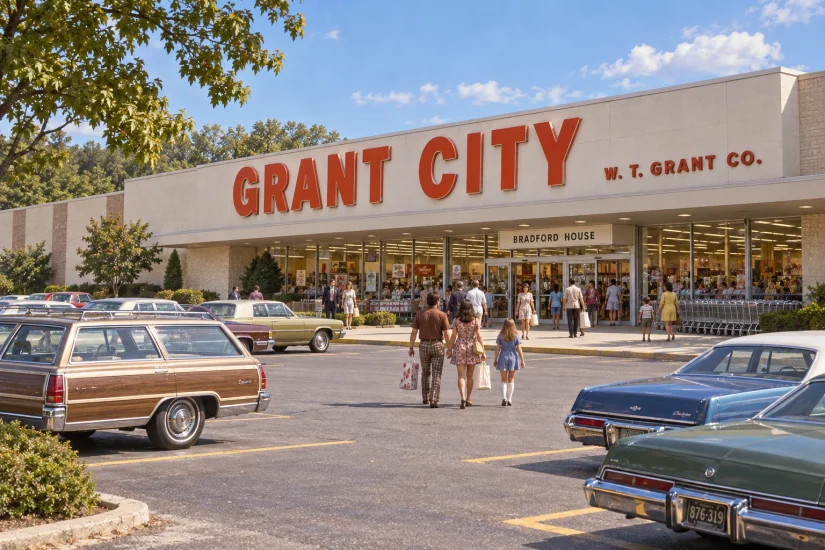
A trip to Grant City could include shopping for household necessities and sitting down for a meal.
For retail historian Eric Johnson, those two experiences remain closely connected. In an interview published by the William T. Grant Foundation, he recalled visiting his neighborhood Milwaukee Grant City as a child, browsing toys and eating at its Bradford House restaurant.
His memories capture how a large store could become part of family life.
The W. T. Grant chain disappeared in 1976, but its variety stores and larger Grant City locations remain familiar names in American retail history.
AT A GLANCE
Place: W. T. Grant
Also known as: Grants; Grant’s; W. T. Grant Co.; Grant City for its larger store format
Historical location: First store in Lynn, Massachusetts; later operated nationwide
Category: Variety stores and larger general merchandise stores
Opened/established: 1906
Closed/disappeared: Bankruptcy proceedings began in October 1975; liquidation followed in 1976
Current status: The original retail chain no longer operates
Remembered for: Household basics, clothing, toys, Bradford electronics, lunch counters, and Grant City shopping
HOW IT BEGAN
William Thomas Grant opened his first store in Lynn, Massachusetts, in 1906.
The business developed around reasonably priced merchandise and grew into a national chain. Its earlier locations followed the variety-store format, offering many everyday purchases in a relatively compact setting.
Over time, the merchandise expanded. Clothing, dry goods, household hardware, and other practical items helped make Grants a regular shopping destination.
A local history of the Spokane stores describes the company advertising itself as “four stores in one.” Furniture also became part of its postwar assortment.
During the 1960s and early 1970s, the company developed larger stores associated with the Grant City name.
These locations reflected the shift toward suburban shopping centers, where customers expected broader selections and convenient parking.
WHAT MADE IT SPECIAL
Grants offered more than one kind of shopping experience.
An older downtown variety store could feel different from a large suburban Grant City. Together, the formats connected the company with several generations of shoppers.
Its store brands added another recognizable feature.
Grantogs appeared on children’s clothing, while Bradford identified electronics and other merchandise. The Bradford name referred to Bradford County, Pennsylvania, where William Thomas Grant was born.
Food service also played a role.
Many locations included Bradford House restaurants. Other lunch counters used The Skillet name. The restaurant offering varied by location, so not every Grants had the same dining arrangement.
In Spokane, a downtown store that opened in 1954 included a 53-seat lunch counter. It illustrates how shopping and a meal could fit within the same visit.
Those combinations helped make the stores useful places to spend part of a day. Customers could browse practical goods, purchase clothing, and take a break before heading home.
THE FINAL CHAPTER
By the mid-1970s, the company faced serious financial problems.
Its difficulties included adapting to changing shopping patterns, managing expansion, and absorbing the consequences of an overly generous customer-credit program.
In the William T. Grant Foundation interview, historian Eric Johnson describes the collapse as the result of several problems coming together, including credit extended beyond what the business could support.
The company filed a Chapter XI petition on October 2, 1975.
The Securities and Exchange Commission’s 1976 annual report records approximately 1,070 stores and 62,000 employees at the time of that filing.
Closures followed quickly. Between November 1975 and January 1976, 712 stores were liquidated.
On February 12, 1976, the court ordered liquidation of the remaining 359 stores. The SEC report records the company’s adjudication as bankrupt on April 13.
The ending affected customers, employees, suppliers, and communities across the country. A chain built over decades disappeared within months.
WHAT’S THERE NOW?
Former W. T. Grant and Grant City properties have separate histories.
Some downtown buildings survived under new uses. Larger suburban locations could be occupied by replacement retailers, divided among tenants, or redeveloped.
A confirmed street address is needed to establish the present condition of any particular store.
Archival collections preserve another connection. Everett Public Libraries in Massachusetts, through NOBLE Digital Heritage, maintains historical material about a local W. T. Grant store.
The William T. Grant Foundation, established by Grant during his lifetime, also preserves information about its founder and the retail business. Its continued work is separate from the former store chain.
Historical sources were reviewed on October 15, 2026. The present use of the first Lynn store and individual former Grant City properties was not independently verified.
DO YOU REMEMBER GRANTS OR GRANT CITY?
Did you shop at a downtown Grants or a larger Grant City? Do you remember eating at Bradford House or owning something with the Bradford name?
Share your memories with Forgotten Spots. Include the town, street, and approximate year if you remember them.
Photographs, advertisements, receipts, shopping bags, restaurant menus, and employee materials can help document the chain. Please identify who owns submitted materials and whether they may be published.
SOURCES AND CREDITS
- William T. Grant Foundation — “Known for Values: William T. Grant on His 150th Birthday”: Eric Johnson’s childhood recollections and historical assessment.
- U.S. Securities and Exchange Commission — Annual Report 1976: Bankruptcy filing, employment, store counts, and liquidation chronology.
- The Spokesman-Review — “Then and Now: W. T. Grant Company”, December 7, 2020: Merchandise, private labels, Spokane stores, and lunch-counter details.
- Everett Public Libraries — W. T. Grant, NOBLE Digital Heritage: Founding information and local archival material.
- W. T. Grant — Historical Overview: Supplemental information about Grant City and restaurant formats.